Best Espresso WDT Tool
Finding the best WDT tool transforms your espresso game by breaking up clumps and distributing grounds evenly. Premium distribution tools make puck prep safer and more enjoyable than ever.
Discover the Best Espresso WDT Tool in 2026 - Subminimal
Why WDT Tools Matter for Espresso Quality
WDT stands for Weiss Distribution Technique, a method developed by John Weiss in the early 2000s that revolutionized home espresso preparation. This technique uses thin needles to stir and break up clumps in coffee grounds before tamping, ensuring water flows uniformly during extraction.
Clumps in your coffee grounds create several problems:
-
Uneven pockets or gaps in the tamped coffee bed
-
Channeling where water finds weak points in the puck
-
Under-extracted or over-extracted areas leading to sour, unbalanced flavors
-
Inconsistent shot quality even with the same beans and grind settings
When you properly distribute grounds with a WDT tool, you create a uniform coffee bed that allows for balanced extraction. The result is consistently better-tasting espresso with improved clarity, sweetness, and body.
Key Features to Consider in a WDT Tool
Selecting the right WDT tool depends on understanding which features impact your workflow and shot quality. Not all distribution tools perform equally, and certain characteristics make a significant difference in daily use.
Needle thickness plays a crucial role in effectiveness. Tools with 0.25mm to 0.4mm needles are most popular among home baristas. Thinner needles (0.25-0.3mm) offer more flex and create smaller trails through the coffee bed, while thicker needles (0.35-0.4mm) provide more rigidity for breaking up stubborn clumps.
Needle count and arrangement affect distribution speed. Most quality tools feature between 6 and 10 needles arranged in strategic patterns. Straight needle designs offer consistent depth control, while planetary or spirographic arrangements cover more surface area with each rotation.
Storage and safety features matter for daily use. Retractable mechanisms, magnetic stands, and protective bases prevent needle damage and keep your workspace tidy. Tools with replaceable needles extend the product's lifespan and maintain consistent performance over time.
Consider portafilter compatibility, handle ergonomics, and build quality when making your selection. Premium materials like surgical-grade stainless steel needles and CNC-machined aluminum bodies ensure durability for years of espresso preparation.
Top 21 Best Espresso WDT Tools in 2026
1. Best Espresso WDT Tool - Subminimal

Description (Flick WDT Tool):
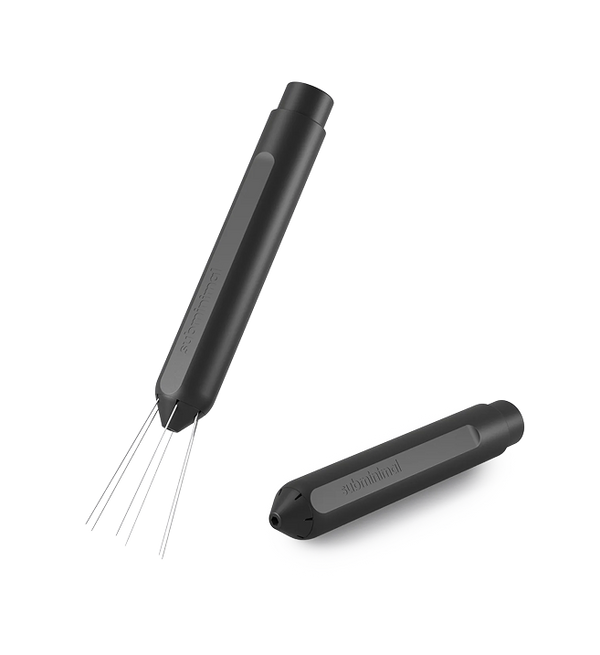
Puck Prep Has Never Been This Fun: The Subminimal Flick is an intuitive, safe, and addictive espresso distribution tool (WDT) featuring retractable needles that pop out with one click and retract with a flick of the wrist. This innovative tool transforms mundane puck prep into a delightful ritual while delivering professional distribution results. Ships with 0.5mm needles installed plus 0.35mm replacement needles.
Key Features:
-
Retractable Needle System: One-click deployment, flick-to-retract magnetic mechanism
-
Safe Design: No needles poking out when not in use, no more bent or caught needles
-
Dual Needle Sets: 0.5mm needles installed + 0.35mm replacement needles included
-
Magnetic Release Mechanism: Lightning-fast deployment with Hyperloop-like internal system
-
Replaceable Needles: Two full sets of replacement needles included with allen wrench
-
42mm Needle Length: Optimal length for proper espresso distribution
-
Dual Stand Options: Aluminum base or magnetic mount for espresso machine/wall
-
Compact & Lightweight: 48 grams / 1.3oz, dimensions 110x18x18mm
-
Addictive Design: Like a fidget spinner for baristas, intuitive and fun to use
-
Professional Results: Eliminates clumps, improves extraction, enhances flavor clarity
Pricing:
-
Price: $29.00 USD
-
Benefits: Same-day shipping, 30-day returns, warranty included, secure checkout
Why Choose Subminimal Flick WDT Tool:
Transform espresso prep from mundane task to delightful ritual with this ingenious WDT tool rated 4.8/5 stars by 352 coffee lovers. The Flick solves the most infuriating problem with traditional WDT tools, pesky needles sticking out, getting caught, bent, or damaged. The magnetic release mechanism pops needles out so fast cameras can't catch them, then a natural flick of the wrist retracts them instantly. Customers rave: "This is the tool I needed all along to get the ideal espresso, it extended the extraction time and helped bring out more flavor notes in each shot." Users note it's "not just a good tool, it's a pleasure to use" and since using it, "coffee flavors are clearer." Even skeptics become fans: "I was honestly skeptical...but I can say it's been one of the best purchases I made lately." The addictive mechanism is so fun "you won't want to stop flicking it!" Perfect for breaking clumps, improving extraction consistency, and elevating your entire coffee preparation experience. Compact design with magnetic mounting keeps it handy on your machine and out of view. Two needle thickness options let you customize distribution intensity.
Discover Also:
2. The WDT Tool - Crema Coffee Products

The Crema Coffee Products WDT Tool delivers precise control for home baristas seeking smoother espresso extractions every day. Its solid stainless steel body pairs with a soft silicone grip in a slim pen-like shape that sits comfortably in the hand during circular stirring motions. Six removable 0.4 mm pins (three installed and three spares) store safely in a built-in vault, making the tool ideal for travel with compact machines. The three-pin layout keeps the profile narrow enough for smaller baskets while still breaking clumps thoroughly and creating a fluffy, even bed. Users report fewer channels and more balanced shots with clearer sweetness once the grounds settle properly. Durable construction and thoughtful storage features make this a reliable daily companion that elevates puck preparation without adding bulk to the workflow.
-
Thin wire construction for effective clump breaking
-
Designed to prevent channeling and spurting during extraction
-
Comfortable grip with ergonomic handle design
-
Available with 0.4mm pins in 6-pin configuration
-
Includes storage vault for safe needle protection
-
Helps achieve more uniform and flavorful espresso
-
Solid stainless steel construction with silicone grip
-
Praised by professional baristas for unique design
3. WDT Tools - Amazon

Amazon hosts an extensive range of WDT tools that cater to every budget and preference for espresso enthusiasts shopping online. Options span simple wooden-handled models to advanced magnetic designs, typically featuring six to ten needles in thicknesses from 0.25 mm to 0.4 mm. Many listings include replacement pins, protective stands, and Prime-eligible shipping for quick delivery. Popular choices from brands available on the platform emphasize clump-breaking performance and even distribution that reduce channeling. Customer reviews supply practical insights into real-world durability and ease of use across different portafilter sizes. This marketplace variety lets buyers compare prices starting around twelve dollars up to premium builds, ensuring a suitable tool for beginners and experienced baristas alike who want flexible, accessible puck prep solutions.
-
Wide variety of needle configurations (6-10 needles typical)
-
Prices range from $12 to $50+ depending on features
-
Common needle thicknesses include 0.25mm, 0.35mm, and 0.4mm
-
Many include magnetic stands or storage solutions
-
Popular brands include Normcore, MiiCoffee, WISSXOER, and Ezebesta
-
Customer reviews provide real-world performance feedback
-
Often bundled with replacement needles for extended use
-
Quick shipping with Prime eligibility on many models
-
Some models feature retractable or adjustable depth mechanisms
4. WDT Distribution Tool V2 - Normcore Coffee Tools

Normcore Coffee Tools presents the WDT Distribution Tool V2 as a refined option for consistent espresso puck preparation. Nine 0.2 mm stainless steel needles crafted from food-grade 304 material create an ultra-fine stirring pattern that covers a wide area inside the basket. The anodized aluminum CNC-machined body feels solid and balances well during use, while the magnetic top allows convenient storage directly on most espresso machines. A set of five extra replacement needles extends the tool’s lifespan for regular home use. The 90 mm total length with 50 mm wire reach works effectively in standard portafilters, promoting richer flavor balance by eliminating dense pockets. Home baristas value the precision design that transforms uneven grounds into a uniform bed ready for tamping and extraction.
-
9 stainless steel prongs made from 304 food-grade material
-
0.2mm needle thickness for ultra-fine distribution
-
Wide stirring area prevents channeling effectively
-
Total length of 90mm with 50mm wire length
-
Precision pin design enhances flavor extraction
-
Includes 5 extra replacement needles for longevity
-
Magnetic top allows storage on espresso machine
-
Compatible with standard espresso portafilters
-
Delivers richer, more balanced espresso shots
5. Flair WDT Tool - Flair Espresso

The Flair WDT Tool focuses on thoughtful needle geometry tailored for reliable home espresso workflows. Seven 0.25 mm needles sit at a nine-degree peripheral angle and span 24 mm, ensuring thorough coverage across various basket sizes including Flair-specific portafilters. The 38 mm needle length reaches deep into the coffee bed for complete clump disruption. A custom pedestal provides stable storage and travel protection, keeping needles straight between sessions. Made in California, this tool prioritizes stiffness, number, and arrangement to avoid the weak performance common in lower-quality alternatives. Users achieve more repeatable extractions with improved clarity once grounds form a fluffy, even layer. The design supports both dedicated Flair owners and those using standard 58 mm setups seeking balanced daily results.
-
7 needles at 0.25mm thickness for gentle distribution
-
38mm needle length reaches deep into portafilter baskets
-
9-degree peripheral needle angle optimizes coverage
-
24mm needle span works with various basket sizes
-
Custom pedestal included for storage and travel
-
Compatible with all Flair portafilters and standard 58mm baskets
-
Helps achieve balanced, repeatable extractions
-
Designed specifically for home barista workflows
-
Made in the United States (California)
6. Spirographic Espresso Distribution WDT Tool - Lastaforest

Lastaforest introduces a dynamic approach with its Spirographic Espresso Distribution WDT Tool that turns distribution into a precise mechanical process. A planetary gear system drives the needles in overlapping geometric paths that leave almost no area of the coffee bed untouched. The adjustable height mechanism offers an 11 mm range for fine-tuning depth according to dose size. High-quality materials ensure durability while the compact form factor fits easily on any counter. Effortless spinning breaks clumps uniformly and creates consistent dispersion without heavy manual effort. Portable construction supports travel or multi-machine households. This geared design appeals to baristas who enjoy visual feedback and thorough coverage in one smooth motion, resulting in more even extractions and fewer channeling issues shot after shot.
-
Planetary gear equipment for precise distribution
-
Creates spirographic patterns for complete coverage
-
Adjustable height mechanism (11mm range)
-
Effortless needle operation breaks up clumps uniformly
-
Durable construction with high-quality materials
-
Compact and portable design fits any workspace
-
Versatile functionality for various basket sizes
-
Geared spinning mechanism for even dispersion
-
Designed in China with worldwide shipping
7. V3 Espresso Rotary WDT Tool - IKAPE

The IKAPE V3 Espresso Rotary WDT Tool upgrades traditional stirring with a spring-loaded press-and-rotate system inspired by efficient motion. Eight to ten ultra-fine 0.25 mm needles arranged in a planetary layout activate with a light push, spinning automatically to break clumps before springing back. Adjustable depth accommodates 16 g to 22 g doses in 58 mm baskets, while a magnetic dosing funnel attaches securely to contain grounds. CNC aluminum construction delivers a heavy, premium feel backed by ten spare needles for long-term maintenance. Protective storage base keeps the tool safe between uses. This one-push operation simplifies aggressive distribution for users who want thorough results with minimal wrist work, leading to fluffier beds and more balanced espresso flavors.
-
8-10 ultra-fine 0.25mm steel needles in planetary layout
-
Spring rebound mechanism for automatic rotation
-
Adjustable depth to accommodate 16g-22g doses in 58mm baskets
-
One-push operation for effortless distribution
-
Magnetic dosing funnel attaches to prevent ground spillage
-
Includes protective storage base for needle safety
-
CNC aluminum construction with premium build quality
-
Comes with 10 spare needles for maintenance
-
Heavy, substantial feel with excellent craftsmanship
8. LUCCA WDT Tool - Seattle Coffee Gear

Seattle Coffee Gear offers the LUCCA WDT Tool as a practical addition to any professional-style espresso station. Surgical-grade stainless steel needles in a six-to-eight configuration measure 0.4 mm thick for effective clump crumbling and raking into a level surface. The included stainless steel stand protects the pins and keeps the workspace organized. Precision engineering pairs naturally with dosing funnels to prevent mess during vigorous stirring. Compatible with all standard portafilter sizes, the tool supports consistent extractions by removing uneven density throughout the bed. Quality finishes match the broader LUCCA accessory line, making it a cohesive choice for baristas focused on workflow efficiency and repeatable shot quality day after day.
-
6-8 surgical-grade stainless steel needles
-
0.4mm needle thickness for optimal rigidity
-
Stainless steel stand included for safe storage
-
Precision-engineered for consistent extraction
-
Compatible with all standard portafilter sizes
-
Helps eliminate uneven coffee distribution
-
Designed with barista workflow in mind
-
Part of LUCCA Accessories collection with quality finishes
-
Distributed by Seattle Coffee Gear (United States)
9. WDT Tool with Stand - MiiCoffee

MiiCoffee equips its WDT Tool with Stand for efficient and organized espresso distribution. Nine strategically placed 0.4 mm stainless steel needles come pre-installed, with an extra set of softer 0.25 mm needles for flexible technique options. Three strong magnetic points allow secure attachment to any steel espresso machine surface, keeping the tool always within reach. Food-safe construction balances rigidity for stubborn clumps with enough flex for gentle passes. The magnetic stand maintains a tidy counter while the uniform stirring action effectively prevents channeling. Versatile compatibility across machines makes this a straightforward upgrade for home users seeking cleaner workflow and more consistent flavor profiles from every shot.
-
9 needles spread strategically for efficient distribution
-
0.4mm diameter stainless steel needles pre-installed
-
Additional set of 0.25mm needles included for soft flex option
-
3 strong magnetic mounting points for machine attachment
-
Food-safe stainless steel construction
-
Perfect combination of rigidity and flex for clump removal
-
Magnetic stand keeps workspace organized
-
Uniform stirring prevents channeling effectively
-
Versatile compatibility with various espresso machines
10. Wirsh WDT Tool - Wirsh

Wirsh builds its WDT Tool around premium 304 food-grade stainless steel for reliable daily performance. Ten 0.4 mm precision needles handle clump breaking and even distribution with solid control. An ergonomic handle provides a comfortable grip during extended stirring sessions, while the magnetic base attaches easily to metal surfaces for quick access. Ten replacement needles and a dedicated stand support long-term use and safe storage. Thickened foam packaging protects the tool during shipping. A two-year hassle-free replacement warranty adds confidence. The design reduces channeling risk and promotes balanced flavor extraction, appealing to baristas who prioritize convenience, durability, and organized puck preparation routines.
-
10 stainless steel needles at 0.4mm thickness
-
Premium 304 food-grade stainless steel material
-
Ergonomic handle design for comfortable grip
-
Magnetic base attaches to metal surfaces for easy access
-
Includes stand for safe storage when not in use
-
10 replacement needles included for long-term use
-
Reduces channeling risk for balanced flavor profiles
-
Compatible with various espresso machines and portafilters
-
Two-year hassle-free replacement warranty
-
Thickened foam packaging protects needles during shipping
11. Pesado WDT Tool

Pesado brings Australian specialty coffee precision to its WDT Tool with a focus on complete 58 mm basket coverage. The weighted handle improves control during fine stirring passes, allowing deliberate clump-breaking without fatigue. Food-grade stainless steel needles and a magnetic stand complete the package, with a replaceable needle set for ongoing maintenance. Build quality matches the brand’s reputation for high-end tampers and accessories, delivering a substantial feel that serious home baristas and café operators appreciate. The needle arrangement prioritizes thorough density uniformity across the bed. While optimized primarily for full-size baskets and positioned at a premium price point, the tool rewards users who invest in meticulous puck prep with more controlled extractions and refined espresso character.
-
Key features: Precision-engineered needle arrangement for 58mm baskets, weighted handle for controlled stirring, food-grade stainless steel needles, magnetic stand included, replaceable needle set
-
Pros: Premium build quality consistent with the Pesado accessory range, weighted handle improves stirring control for fine clump-breaking passes, needle arrangement designed for complete basket coverage, strong reputation in the specialty coffee community
-
Cons: Premium pricing at the higher end of the home barista market, primarily optimised for 58mm baskets rather than smaller portafilter sizes
12. Barista Hustle WDT Tool

Barista Hustle designs its WDT Tool with an evidence-based philosophy rooted in specialty coffee education. Founded by Matt Perger, the brand selects needle thickness and count according to documented distribution research rather than appearance alone. Food-grade stainless steel construction pairs with an ergonomic handle and protective storage solution for reliable daily performance. Compatibility centers on standard 58 mm portafilters, supporting consistent technique across shots. The tool carries strong credibility among baristas who value science-driven accessories over marketing claims. Although brand recognition can place it at a higher price relative to similar options and availability stays mostly with specialty retailers, users gain a dependable instrument that reinforces better extraction understanding and repeatable results.
-
Key features: Research-informed needle specification, food-grade stainless steel construction, ergonomic handle design, compatible with standard 58mm portafilters, protective storage solution included
-
Pros: Designed by a brand with deep specialty coffee education credibility, needle specifications backed by extraction research, reliable daily performance for serious home baristas, strong community following among evidence-focused coffee enthusiasts
-
Cons: Brand cachet adds to the price relative to comparable tools, less widely available outside specialty coffee retailers and direct online purchase
13. Nucleus Coffee WDT Tool

Nucleus Coffee Tools approaches WDT design from a pure engineering standpoint with a slim, precision-turned body. The fixed optimal needle depth suits standard 58 mm VST and IMS baskets, removing adjustment variables so every stir remains consistent. Minimalist aesthetics keep the tool unobtrusive on clean modern setups where counter space matters. Food-grade stainless steel needles and natural hand feel support fluid stirring motions without bulk. Compatibility with dosing funnels creates a contained workflow. Fixed depth limits use with unusually shallow baskets and the design omits magnetic storage, yet the clean profile and reduced guesswork appeal to baristas who prefer simplicity and measurable consistency in their daily espresso routine.
-
Key features: Slim precision-turned body, fixed optimal needle depth for standard 58mm baskets, food-grade stainless steel needles, minimalist design, compatible with dosing funnels
-
Pros: Slim profile sits naturally in hand during stirring, fixed needle depth removes adjustment variables for consistent results, clean minimalist aesthetic suits modern espresso setups, pairs well with dosing funnels for a contained workflow
-
Cons: Fixed needle depth limits compatibility with shallower non-standard baskets, no magnetic storage solution included
14. Orea WDT Tool

Orea crafts its WDT Tool around ergonomics and targeted coverage for high-volume specialty coffee use. The handle geometry specifically reduces wrist rotation during circular motions, lowering fatigue when pulling multiple shots. Needle arrangement prioritizes the basket wall area where static and retention often create the worst clumps, alongside central distribution. Stainless steel construction and a protective cap keep the tool ready and safe between uses. Designed for 58 mm portafilters, it delivers thoughtful performance from a brand known for research-driven accessories. Higher pricing and availability mainly through specialty retailers reflect the focus on refined details, yet users gain a tool that addresses common weak points and supports sustained technique across busy sessions.
-
Key features: Ergonomic handle shaped to reduce wrist rotation, edge-focused needle arrangement for wall-area clump coverage, stainless steel construction, protective cap included, designed for 58mm portafilters
-
Pros: Ergonomic design reduces wrist fatigue during high-volume use, edge-focused needle arrangement addresses wall-area clumping that straight-pattern tools can miss, protective cap keeps needles safe between shots, clean design from a respected specialty coffee brand
-
Cons: Higher price point than mid-tier competitors, available primarily through specialty coffee retailers rather than mainstream marketplaces
15. Coffee Sensor WDT Tool

Coffee Sensor delivers German precision engineering in its CNC-machined WDT Tool built for measurable consistency. Adjustable needle depth accommodates different basket depths and dose sizes across multiple machines, while calculated needle spacing ensures complete coverage. Food-grade stainless steel needles, a magnetic stand, and a replacement set support years of daily use without degradation. The brand’s exacting tolerances match its portafilter baskets and other accessories popular in the European specialty scene. Although the adjustable mechanism adds complexity and the price reflects premium manufacturing, the tool suits baristas who switch setups regularly and demand long-term reliability paired with scientific attention to every detail of distribution.
-
Key features: CNC-machined body, adjustable needle depth mechanism, precision-calculated needle spacing, food-grade stainless steel needles, magnetic stand, replacement needle set included
-
Pros: Adjustable depth suits baristas who use multiple basket types or dose sizes, CNC-machined construction delivers measurable build quality consistency, precision needle spacing for complete coverage, strong European specialty coffee reputation
-
Cons: German precision engineering reflects in the price, adjustable mechanism adds complexity that simple fixed-depth tools don't require for single-machine setups
16. Fellow Espresso WDT Tool
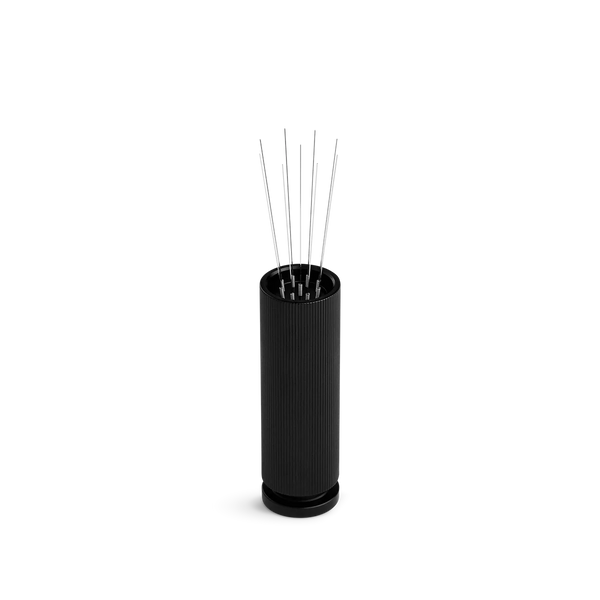
Fellow Products based in San Francisco, California designs the Espresso WDT Tool as a precision instrument for home baristas focused on clump free puck preparation. The aluminum housing features a smooth slide open and close mechanism that fully protects the fine angled needles when not in use and reveals them for stirring. These needles gently rake through coffee grounds to break clumps and promote uniform density across the bed before tamping. The balanced weight supports controlled motion while the compact form stores securely between sessions. Replacement needles remain available to maintain performance over time. This tool integrates into standard 58 mm workflows and emphasizes careful handling of the precision needles to preserve their shape during repeated daily use.
-
Key features: Fine angled metal needles for gentle clump removal, aluminum housing with slide open and close protective mechanism, balanced weight design, secure storage capability.
-
Accurate data and information: Supports even grounds distribution to reduce channeling potential, compatible with standard espresso portafilters, needles treated as precision instruments requiring careful handling, replacement needles offered for ongoing maintenance.
17. Weber Workshops Moonraker
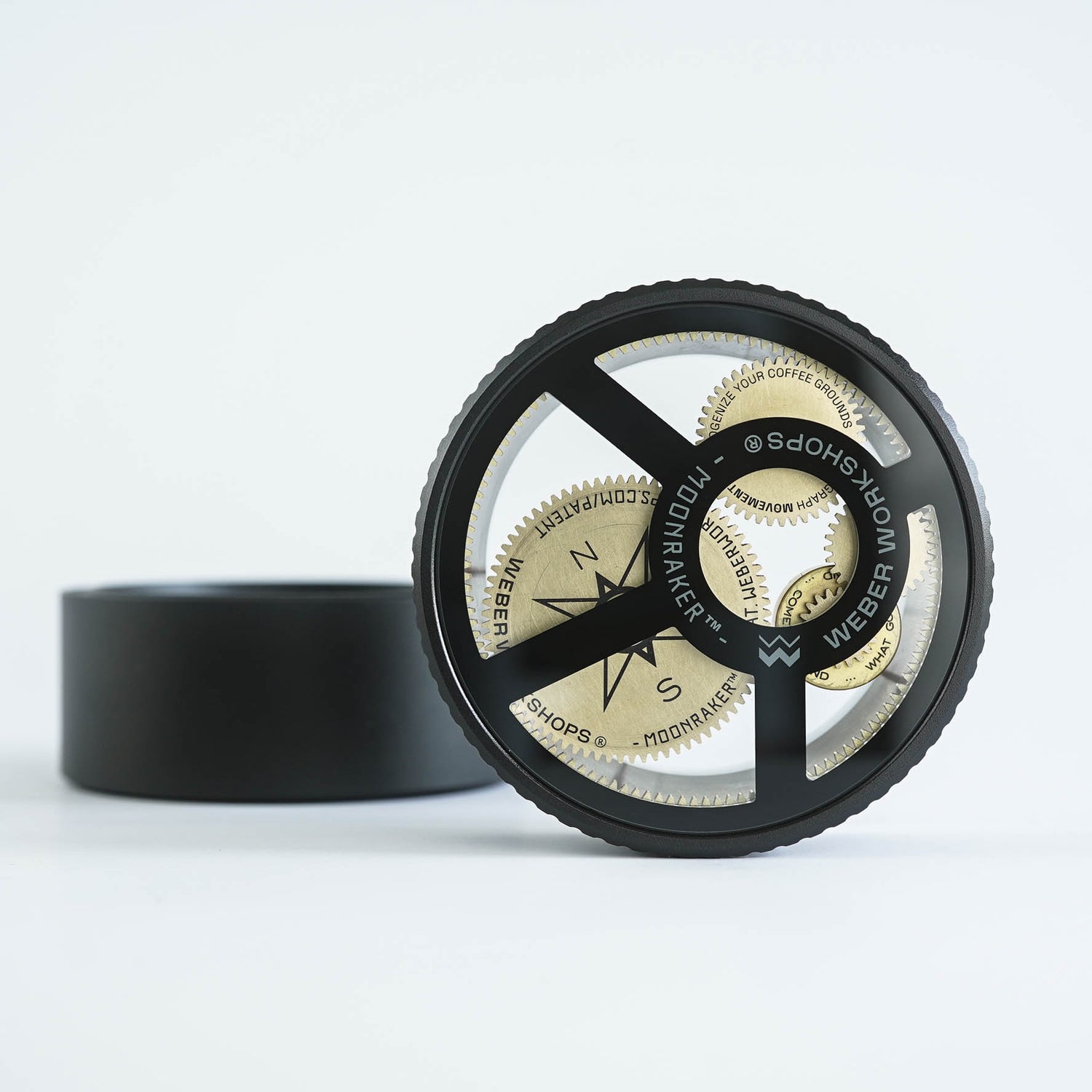
Weber Workshops headquartered in Incline Village, Nevada with operations in Golden, Colorado produces the Moonraker as a mechanized spirographic WDT device for thorough coffee bed homogenization. Ten medical grade stainless steel needles of two gauges and heights sit suspended by neodymium magnets beneath interlocking gears that create randomized paths with each rotation. The aerospace grade aluminum and stainless steel body includes a chemically strengthened glass top for process visibility. Users spin the device with a finger for two or more turns to achieve full randomization without compacted grooves. The included aluminum caddy, coffee brush, and twenty spare needles support customization for different basket depths. Optimized for 18 to 22 gram doses in 58 mm baskets, the tool delivers consistent bed preparation through its patented movement.
-
Key features: Patented spirographic gear movement, ten needles in 200 and 300 micron gauges at dual heights, neodymium magnet needle retention, chemically strengthened glass viewing surface, included caddy brush and twenty spares.
-
Accurate data and information: Dimensions 75 mm diameter by 65 mm height, weight 300 g standard or 405 g ultra edition, works with rounded lip 58 mm baskets, needle depths calculated for deep and surface mixing, more than two turns recommended for full homogenization.
18. ARO Orbit Spirographic Distribution Tool
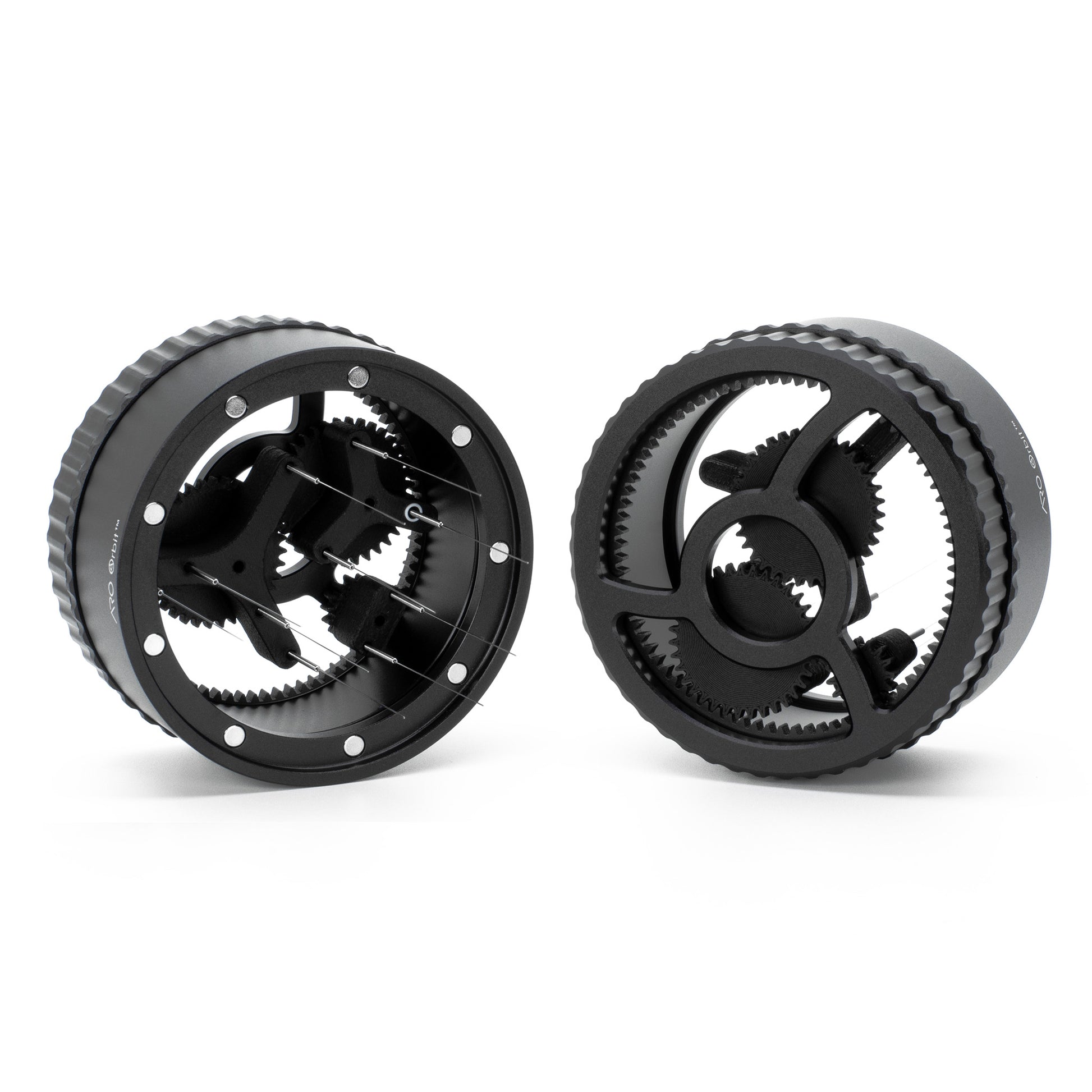
ARO Espresso develops the Orbit series as a geared spirographic WDT solution available for American home baristas seeking mechanical distribution. The design employs three distinct gears labeled the Sweeper Scrambler and Edge Dancer that trace hypotrochoid and epitrochoid paths with ten 0.25 mm precision pins. Adjustable needle length accommodates various basket depths while magnetic or non magnetic sleeves secure the tool for one handed or tabbed use. Constructed from durable materials with self aligning weighted stands the Orbit completes even fluffing in as few as four spins. Multiple finish options and versions for 58 mm 54 mm and 53 mm portafilters expand compatibility across common machines. Hand washing maintains the mechanism for repeated sessions.
-
Key features: Three gear spirographic system with 0.25 mm pins, adjustable needle length, magnetic and non magnetic sleeve options, self aligning weighted stand, versions for 58 mm 54 mm and 53 mm baskets.
-
Accurate data and information: Ten pins included with dulled tips and twenty total pins supplied, base diameters 77 mm for 58 mm and 71 mm for smaller sizes, efficient distribution achieved in four spins, PLA or aluminum construction variants depending on model.
19. Pullman The STIR
Pullman crafts The STIR as a timber handled WDT tool emphasizing natural materials and ergonomic stirring for espresso preparation. Australian natural timbers form the handle while an acetal needle holder secures fine stainless steel needles that break clumps and aerate grounds throughout the basket. The design fits standard filter baskets and supports the Weiss Distribution Technique through controlled circular motions that create uniform density. Easy cleaning and a dedicated wood stand keep the tool ready for daily use. The overall construction prioritizes tactile feedback and balanced weight during the distribution process. Compatibility extends across common portafilter sizes used by home and professional users in the USA market.
-
Key features: Australian natural timber handle, acetal needle holder, stainless steel needles, ergonomic stirring design, dedicated wood stand for storage.
-
Accurate data and information: Incorporates WDT method for clump elimination and even density, fits standard filter baskets, easy to use and clean construction, supports consistent extraction through uniform ground distribution.
20. Aieve WDT Tool

Aieve supplies its WDT Tool as a magnetic coffee distribution option widely available to USA baristas through major marketplaces. Food grade hard plastic and 304 stainless steel form the body and needles which measure 0.4 mm for effective clump disruption. A magnetic stand or base keeps the tool organized on metal surfaces while the overall layout supports stirring in standard portafilters. Multiple needle counts and storage features appear across variants to extend usability. The design focuses on straightforward de clumping and even bed formation prior to tamping. Users incorporate it into Breville and similar machine workflows common in American households for improved ground uniformity.
-
Key features: 0.4 mm 304 stainless steel needles, food grade hard plastic body, magnetic stand or base, storage for needles, compatibility with common home espresso machines.
-
Accurate data and information: Thickened needles for texture and durability, magnetic attachment for workspace organization, designed for Breville style and standard portafilters, supports WDT stirring to increase extraction consistency.
21. Knocdic Espresso WDT Tool with Standing Holder
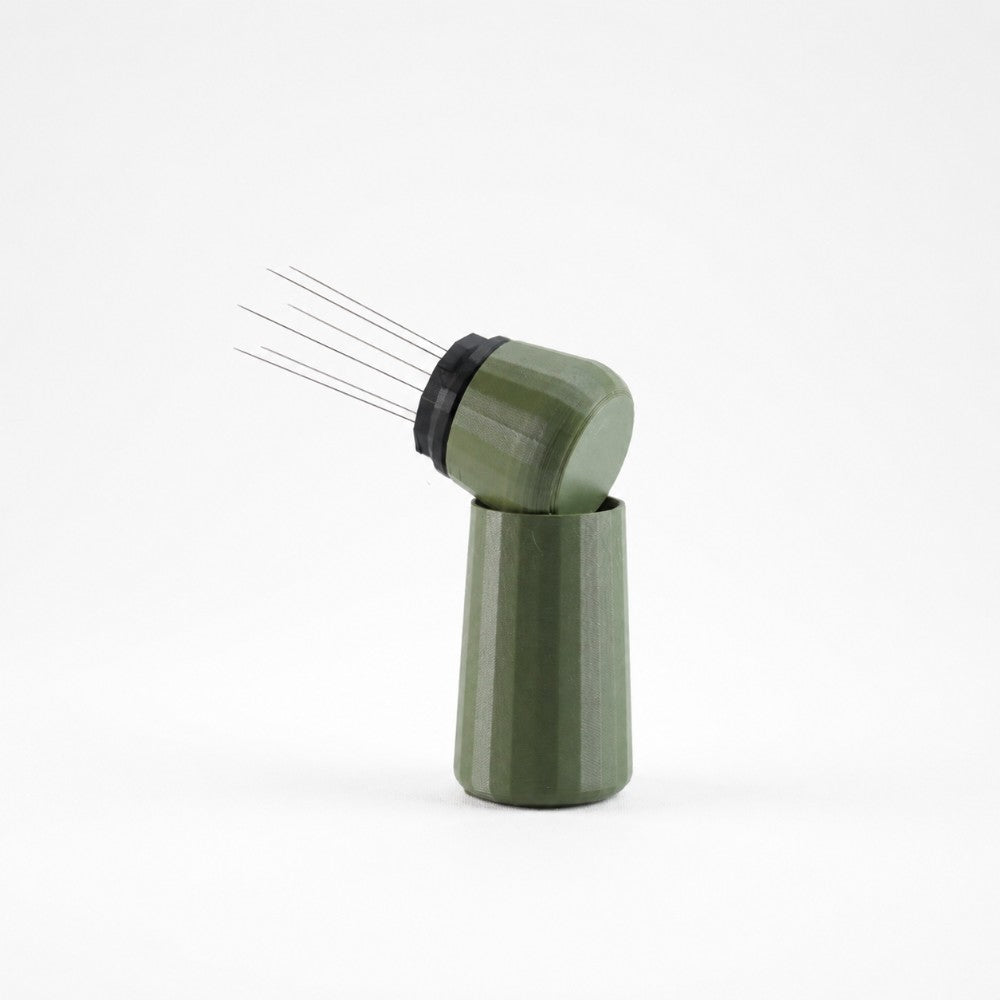
Knocdic offers a 3D printed WDT tool with integrated standing holder tailored for multi size espresso workflows popular among USA home users. Compatible with 51 mm 54 mm and 58 mm baskets the design uses durable printed materials paired with stainless steel needles for clump breaking and distribution. The standing holder provides stable storage and easy access during prep sequences. Lightweight construction suits frequent daily sessions while the needle arrangement promotes fluffy even beds. Hand crafted elements and adjustable aspects appear in related listings to match individual basket depths. This option serves baristas seeking affordable specialized tools outside mass market brands.
-
Key features: 3D printed body with standing holder, stainless steel needles, multi size compatibility for 51 mm 54 mm and 58 mm, lightweight design, stable storage base.
-
Accurate data and information: Works across common portafilter sizes found on home machines, focuses on smoother consistent espresso prep, suitable for regular puck preparation routines, printed construction allows custom adaptations.
WDT Tools vs. Distribution Levelers: Understanding the Difference
Two tools dominate the puck prep conversation , WDT needle tools and distribution levelers , and they're often compared as alternatives when they actually serve different purposes in the workflow. Understanding what each does and when to use them helps you build a puck prep routine that addresses both distribution and leveling without doubling up unnecessarily. Subminimal's full guide on the art of using a WDT tool covers this in more detail alongside technique guidance.
WDT tools break up clumps throughout the entire coffee bed. The needles reach into the full depth of the portafilter basket to physically separate clumped grounds from the bottom up, eliminating the dense pockets and air voids that cause channeling during extraction. This three-dimensional distribution work , addressing the entire volume of coffee, not just the surface , is something a distribution leveler cannot replicate. A leveler applied to a clumped bed simply creates a flat surface over uneven distribution underneath, which still produces channeling and inconsistent extraction.
Distribution levelers address surface levelness and minor top-layer variation. OCD-style levelers and similar tools spin across the top of the coffee bed to create a flat, even surface before tamping. They work well for settling and leveling grounds that are already reasonably distributed, and some designs incorporate a slight redistribution action at the surface. But they don't reach deep into the bed where the most problematic clumping occurs, particularly in the lower third of the basket near the shower screen.
The most effective puck prep workflow uses both in sequence:
-
Dose grounds into portafilter with a dosing funnel to contain spillage
-
Use a WDT tool , like the Flick , to break up clumps throughout the full depth of the bed
-
Tap portafilter gently once or twice to settle the distributed grounds
-
Apply a distribution leveler if you use one to create a flat, even surface
-
Tamp with consistent pressure
For home baristas choosing between the two tools, a WDT tool delivers more meaningful extraction improvement because it addresses the root cause of channeling , clumping throughout the bed , rather than surface variation alone. If you can only buy one, start with a quality WDT tool and add a leveler later once your distribution technique is consistent.
WDT Tools and Dosing Funnels: Why They Work Together
The WDT tool and dosing funnel are the two most complementary accessories in puck prep, and using them together produces better results than either tool alone. Despite this, many home baristas own one without the other , usually a WDT tool , and limit their distribution effectiveness as a result. Subminimal's dosing cup and Subscale guide covers how the full puck prep accessory workflow fits together for consistent results.
A dosing funnel solves the containment problem that limits aggressive WDT technique. Without a funnel, vigorous stirring , the kind that actually breaks up deep clumps and creates a fluffy, uniform bed , sends grounds over the rim of the portafilter. This forces baristas to use timid, surface-level stirring that leaves lower-bed clumps intact. A funnel extends the effective height of the basket, giving you the clearance to stir thoroughly from the bottom up without grounds escaping. The result is that your WDT tool can do its actual job rather than a cautious approximation of it.
Funnel compatibility matters when choosing a WDT tool. Most quality dosing funnels sit flush on standard 58mm portafilter baskets, and WDT tools with handles longer than roughly 100mm clear the funnel rim during stirring. The Flick WDT Tool's 110mm length and retractable needle system work naturally with funnels , needles deploy into the basket through the funnel opening and retract safely with a wrist flick when you're done, without the needle-catching risk that fixed-needle tools have when working inside a funnel.
Choosing the right funnel for your portafilter size:
-
58mm portafilters (most full-size espresso machines): Standard dosing funnels fit directly and work with virtually every WDT tool on this list
-
54mm portafilters (Breville Barista Express, Sage series): Look for 54mm-specific funnels , standard 58mm funnels won't seat securely and can wobble during distribution, defeating the containment purpose. Subminimal's 54mm dosing cup collection covers compatible options
-
Bottomless portafilters: Funnels work identically on bottomless portafilters and are arguably more useful since the open bottom makes any spillage during distribution more visible and harder to recover
Practical funnel tips for better WDT results:
-
Place the funnel before dosing, not after , grounds dosed directly into the funnel sit more naturally than grounds transferred into a funnel placed on top
-
Use the funnel's rim as a visual guide for stirring height , keeping needles below the rim during WDT ensures full basket depth coverage
-
Clean the funnel after each session along with your WDT tool , coffee oils accumulate on funnel rims and can affect how grounds settle at the basket edge
-
Magnetic funnels that attach directly to the portafilter basket offer the most stable platform for WDT technique, particularly with aggressive clump-breaking passes
Understanding Needle Thickness and Count
The specifications of your WDT tool's needles directly impact distribution effectiveness and shot quality. Needle thickness typically ranges from 0.2mm to 0.4mm, with each size offering distinct advantages for different preferences and techniques.
Thinner needles (0.2mm-0.3mm) provide more flexibility. These ultra-fine needles create minimal disruption to the coffee bed while breaking up clumps, leaving smaller trails that close up more easily during tamping. Many baristas prefer 0.25mm needles for their extra flex, which allows gentle distribution without compacting grounds.
Medium thickness needles (0.35mm) offer balanced performance. This size provides a middle ground between flexibility and rigidity, making it the most commonly recommended thickness by tool designers and experienced baristas.
Thicker needles (0.4mm) deliver maximum clump-breaking power. These sturdy needles effectively pulverize stubborn clumps and maintain their shape during aggressive stirring. They work particularly well for raking the top layer of grounds and creating a level surface before tamping.
Needle count matters too. Tools with 6-7 needles allow precise, controlled stirring with good spacing between each needle. Models with 9-10 needles cover more ground with each pass, speeding up the distribution process while still maintaining effectiveness.
Mastering Your WDT Technique
Proper technique transforms a good WDT tool into exceptional espresso. The way you use your distribution tool matters just as much as the tool itself, and developing consistent habits ensures repeatable results shot after shot.
Start with a dosing collar or funnel. This accessory contains grounds during distribution, preventing mess and allowing more aggressive stirring to break up clumps effectively. Without a collar, you'll spend three times longer trying to avoid spilling grounds everywhere.
Begin stirring at the bottom of the basket. Insert your WDT tool needles to the full depth of your coffee bed and use gentle circular motions to distribute grounds from bottom to top. This approach addresses clumps throughout the entire puck, not just the surface layer.
Use light, consistent pressure. Heavy-handed stirring can compact grounds or create new problems instead of solving them. Let the needles do the work by moving through the coffee with minimal resistance, focusing on breaking up visible clumps and creating a fluffy texture.
Aim for 10-15 seconds of distribution time. This duration provides thorough coverage without overthinking the process.
Finish with a gentle tap before tamping. After WDT, tap your portafilter once or twice on your counter to settle grounds into an even layer. This final step creates a level surface that's ready for consistent tamping pressure.
Caring for Your WDT Tool
Maintaining your distribution tool properly extends its lifespan and ensures consistent performance over years of daily espresso preparation. These simple care practices take minutes but make a significant difference in tool longevity.
Clean needles after each use. Coffee oils and fine particles accumulate on needles quickly, affecting their ability to glide smoothly through grounds. Wipe needles with a dry cloth or use a small brush to remove stuck grounds immediately after each session.
Store tools safely to prevent needle damage. Bent needles create uneven distribution patterns and can scratch your portafilter basket. Use included stands, magnetic mounts, or protective cases to keep needles straight and protected when not in use.
Replace bent or damaged needles promptly. Most quality WDT tools include spare needles for exactly this reason. Don't struggle with compromised needles when fresh replacements restore optimal performance immediately.
Check magnetic attachments periodically. If your tool uses magnets for storage or mounting, ensure they remain secure and clean. Coffee dust can accumulate around magnetic surfaces, weakening their hold over time.
Avoid dishwashers for wooden or composite handles. While stainless steel needles tolerate moisture well, wooden handles and certain aluminum finishes can degrade with repeated water exposure and high heat.
Best Budget WDT Tools for Espresso (Including DIY Options)
Budget WDT tools give home baristas a simple way to break up clumps and create a more even coffee bed. Even basic needle designs improve extraction consistency without a large investment.
DIY versions work well for testing the technique. Straighten a few thin sewing or acupuncture needles and push them into a cork or wooden handle. Aim for six to eight needles around 0.3 mm to 0.4 mm thick with about 40 mm of exposed length. This reaches the bottom of most baskets and still fluffs grounds enough to reduce channeling. Many people keep their first DIY tool as a backup even after they move to a finished model like the Flick WDT Tool.
Ready-made budget WDT tools follow the same principle. They use stainless steel needles in a basic handle and often include a small stand. Needle flex and spacing matter most. Thinner needles leave finer trails that close during tamping. Wider spacing covers the full bed in fewer passes. Simple designs still deliver clear improvements in daily shots.
The Flick WDT Tool occupies a useful middle ground. Its retractable magnetic system keeps the needles safe between uses. One click deploys them. A natural wrist flick pulls them back. The body stays light and the 42 mm needle length suits standard baskets. Replacement needles in both 0.5 mm and 0.35 mm sizes extend its life. Baristas who weigh with the Subscale often place the Flick next to it because accurate dosing and thorough distribution form a natural pair. The combination produces clearer, sweeter shots with less mess.
Storage remains straightforward. A magnetic base or small stand protects the needles. A quick wipe after each use prevents oil buildup. When needles bend, a fresh set restores performance. The Flick needles pack makes that swap simple, and the spare parts collection keeps extras on hand.
Budget tools work especially well with a dosing funnel. The funnel walls contain the grounds so the needles can stir deep without spills. After distribution, a light tap settles the bed for tamping. This short sequence works on any machine and any roast. Light roasts benefit most because they clump more readily from static. Stations that already use the Subscale for weighing often keep a funnel and the Flick WDT Tool in the same workspace for a complete, low-clutter prep flow. Starting with a simple tool builds good habits. Moving to a retractable design later keeps those habits comfortable and the counter tidy.
How to Choose the Best WDT Tool for Your Portafilter Size & Machine
Portafilter size shapes every WDT decision. Full-size machines most often use 58 mm baskets. Compact machines, including many Breville and Sage models, use 54 mm. Matching needle span and length to the basket lets the tool reach full depth without scraping the walls.
For 58 mm baskets the tool needs enough outer reach to clear the edges. A straight or lightly angled set of eight needles covers the bed well. Needle length of 40 mm to 45 mm reaches the bottom of deeper baskets that hold 18 g to 22 g doses. Handles that clear a dosing funnel keep the motion free. The Flick WDT Tool fits this size cleanly, and its retractable needles work smoothly inside magnetic funnels that sit on the rim.
54 mm baskets need a narrower span. Needles that stick out too far hit the walls and bend. Compact heads or adjustable-depth designs handle the tighter space. Fixed-depth tools made for 58 mm can still work on 54 mm when the motion stays centered. Pairing the tool with the Subscale keeps bed height consistent because exact dose weight removes one variable across basket sizes.
Bottomless portafilters reveal results immediately. Channeling shows as spurts or pale streams. A well-matched WDT tool reduces those spots. The UpShot sits on the cup edge and gives a clear view of the extraction so the effect of the distribution becomes easy to judge.
Needle thickness stays relevant for every size. Needles between 0.25 mm and 0.35 mm flex enough to break clumps without compacting the bed. Thicker 0.4 mm needles handle denser light-roast grounds with more force. Most tools ship with one size and include a second set. The Flick arrives with 0.5 mm needles for shipping durability and packs 0.35 mm replacements for daily use. Fresh sets from the Flick needles restore the original light glide.
Ergonomics matter more than many expect. A tool that sits naturally in the hand produces better technique over a full session. Lightweight aluminum bodies reduce wrist strain. Magnetic stands keep the tool ready on the machine or wall.
The rest of the station completes the picture. A digital dosing cup sits beside the grinder. Grounds move from the cup to the portafilter with a funnel. The WDT tool follows. This order keeps mess low and results repeatable.
Choose the tool that matches the baskets used most often. Match needle reach to bed depth. Pick a handle that still feels good after several shots. The right match turns distribution into a quick, reliable step.
Latest News In 2026
The specialty coffee market keeps expanding strongly into 2026, with home espresso setups driving much of the growth as more people chase café-level consistency at home. Prosumer machines, pressure profiling, and better grinders are becoming standard, but the real focus for many baristas has shifted to the small details that make or break a shot, especially puck prep. Precision accessories like WDT tools, distribution devices, and dosing tools are seeing steady demand because even extraction still ranks as one of the biggest levers for better flavor, clarity, and fewer wasted shots.
Across the industry, manufacturers are responding with safer designs, retractable or protected needles, better ergonomics, and tools that fit cleanly into real daily workflows rather than adding steps. Retractable mechanisms, magnetic storage, and multi-use accessories that pair well with milk texturing gear are showing up more often as home users prioritize both performance and convenience.
FAQs
Do WDT tools really prevent channeling in espresso shots?
WDT tools effectively prevent channeling by breaking up clumps and creating uniform coffee distribution throughout the portafilter basket. Clumps create dense areas where water cannot flow easily, forcing it to find weak points and create channels that lead to uneven extraction. By stirring grounds with thin needles before tamping, you eliminate these problem areas and ensure water flows evenly through the entire coffee bed. The result is balanced extraction with improved flavor clarity, sweetness, and consistency compared to shots pulled without proper distribution.
Should I choose thinner or thicker needles for my WDT tool?
Needle thickness between 0.25mm and 0.4mm works well for most home baristas, with the best choice depending on your technique and preferences. Thinner needles (0.25-0.3mm) offer more flexibility and create smaller trails through the coffee bed, making them ideal for gentle, thorough distribution. Thicker needles (0.35-0.4mm) provide more rigidity for breaking stubborn clumps and work well for raking the top layer of grounds flat. Many experienced users prefer 0.35mm as a balanced middle ground that handles both deep distribution and surface leveling effectively.
How long should I spend using a WDT tool for each shot?
Most baristas spend 10-15 seconds distributing grounds with a WDT tool, which provides thorough coverage without overthinking the process. The technique matters more than duration, start by inserting needles to the bottom of your coffee bed and use gentle circular motions to work from bottom to top. Using a dosing collar makes this process faster and cleaner by containing grounds and allowing more confident stirring. With practice, WDT becomes a quick, natural part of your workflow that adds minimal time while dramatically improving shot consistency.
What makes a DIY WDT tool effective for beginners?
A solid cork or dense wooden handle gives the needles a firm grip that stays put during stirring. Soft or crumbly materials let the needles shift and create uneven trails. A slightly longer handle often improves control and reduces hand fatigue on early tries.
How does basket size change the way a WDT tool performs?
Larger baskets hold more grounds at the edges where static pulls particles into clumps. Good outer needle reach clears those wall zones thoroughly. Smaller baskets create a denser bed so the same motion needs fewer rotations. Higher doses raise the bed height and change how deep the needles must travel. Matching the tool span to the basket keeps every pass productive.
Can a WDT tool work together with a digital dosing cup?
The dosing cup sets an exact starting weight so bed height stays predictable. After the grounds transfer into the portafilter the needles move through a consistent volume. Weighing ends and distribution begins without extra steps or mess. The Subscale sits naturally beside the coffee grinder and keeps the sequence compact. Many stations place both tools side by side for a clean handoff while the UpShot waits on the cup for extraction checks.
Why do retractable needles matter for daily espresso prep?
Needles that stay hidden between shots avoid accidental bends from brushes or cloths. The quick deploy-and-store action fits the short window between grinding and tamping. Households with pets or kids gain peace of mind because sharp points never sit exposed. Protected needles keep their original straightness and flex longer.
How often should replacement needles go into a WDT tool?
Needles first show wear as slight bends or a sticky feel from coffee oils. Once the tips lose their clean entry into the bed a fresh set restores performance. Light wiping after each use stretches the life of each pack. Owners of the Flick keep spare sets from the Flick needles ready so a swap takes only a minute with the included hex key.
Does a magnetic stand improve the life of a WDT tool?
A magnetic base parks the tool upright so the needles never rest against hard surfaces. Dust and stray grounds stay off the working ends when the tool hangs on the machine or wall. The stand creates a fixed home spot that speeds the next shot. The included adhesive mount allows vertical storage that frees counter space.
Read Also:
Shop the complete range of espresso accessories at Subminimal to streamline your entire puck prep routine.
Related to this blog:
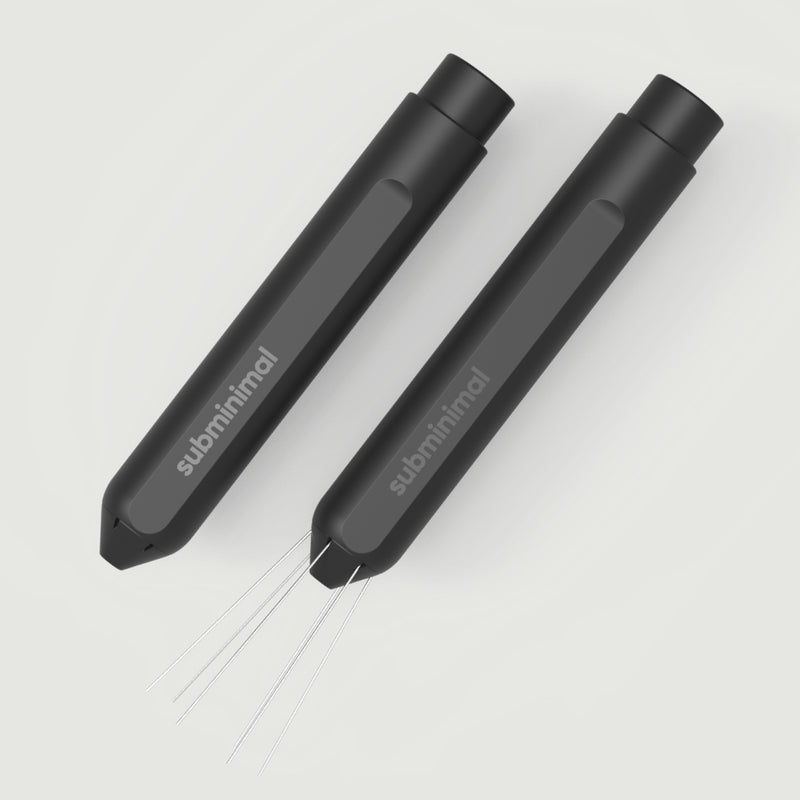
The perfect WDT Tool
It works perfect for me. Doesn't use up too much space, always clean setup and does the job well. Couldn't think of anything for improve.