Best Spinning WDT Tool in 2026
Spinning WDT tools have revolutionized espresso preparation by automating the Weiss Distribution Technique, making it faster and more consistent to achieve even coffee distribution. These best spinning WDT tools feature automated rotation mechanisms that break up clumps and prevent channeling with minimal effort, delivering barista-quality results at home. Discover the Best Spinning WDT Tool in 2026
Explore the complete collection of premium Spinning WDT Tool - Subminimal
Why Spinning WDT Tools Matter for Espresso Quality
The Weiss Distribution Technique addresses one of espresso's biggest challenges: uneven coffee grounds create channeling, where water flows through weak spots rather than extracting evenly. Spinning WDT tools take this technique to the next level by automating the stirring motion, ensuring comprehensive coverage across the entire coffee bed.
Key benefits of spinning WDT tools include:
-
Faster distribution: Automated rotation covers the basket in seconds rather than requiring manual circular motions
-
Consistent coverage: Planetary or gear-driven mechanisms ensure every area receives equal attention
-
Reduced user error: Spring-loaded or bearing systems maintain optimal needle depth and speed
-
Enhanced clump breaking: Continuous rotation breaks up stubborn aggregates more effectively
When choosing the best espresso distribution tool, spinning models offer significant advantages over manual alternatives for both beginners and experienced baristas seeking efficiency and consistency.
Critical Features in Spinning WDT Tools
Modern spinning WDT tools incorporate several design elements that distinguish superior models from basic alternatives. Understanding these features helps you select the right tool for your espresso workflow.
Needle Specifications
The needle count, thickness, and material directly impact distribution effectiveness. Most spinning tools feature 0.25mm to 0.5mm stainless steel needles arranged in specific patterns. Thinner needles (0.25-0.35mm) penetrate dense grounds more easily, while thicker needles (0.4-0.5mm) offer greater durability.
Needle count typically ranges from 8 to 24 pins:
-
8-10 needles provide targeted clump breaking with faster operation
-
16-24 needles offer more thorough distribution for larger baskets
-
Planetary or spirographic arrangements optimize coverage patterns
Rotation Mechanisms
Spring-loaded rotation: Press down and the tool automatically spins, then rebounds to the starting position. This design provides consistent speed and depth control.
Gear-driven systems: Planetary gears create spirographic patterns that cover the entire basket surface efficiently. Ball bearings ensure smooth, consistent rotation.
Manual spin designs: Some models require you to manually rotate while pressing down, offering more tactile control over speed and coverage.
Portafilter Compatibility and Adjustability
Quality spinning WDT tools accommodate multiple basket sizes through adjustable needle depth. Look for models compatible with 51mm, 53mm, and 58mm portafilters that allow you to dial in the perfect needle penetration for different dose sizes (16g to 22g). The Flick WDT tool and similar premium options include magnetic dosing funnels that attach to prevent grounds from escaping during rotation.
Top 8 Best Spinning WDT Tools in 2026
1. Subminimal - Best Spinning WDT Tools in 2026

Description (Flick WDT):
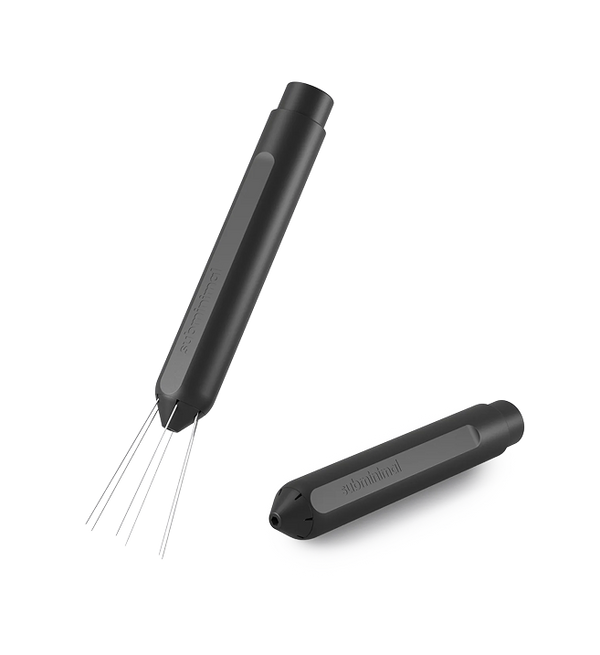
Revolutionary Retractable Design: The Subminimal Flick transforms espresso puck preparation from a mundane task into a delightful ritual. This innovative WDT (Weiss Distribution Technique) tool solves the most frustrating problem with traditional distribution tools, pesky needles constantly sticking out, getting caught, bent, or becoming hazardous. With an ingenious one-click deployment and flick-to-retract mechanism, the Flick makes puck prep enjoyable, safe, and addictively fun. The magnetic release system propels needles out so fast cameras can barely catch them, while a simple flick of the wrist retracts them instantly. Designed like a fidget spinner for baristas, this tool ensures even distribution of coffee grounds for perfect espresso extraction while being satisfying to use every single time. Ships with 0.5mm needles installed and includes 0.35mm replacement needles for customized distribution preferences.
Key Features:
-
One-Click Deployment: Press the top like a pen to instantly extend needles for puck preparation
-
Flick-to-Retract Mechanism: Quick flick of the wrist retracts needles safely and satisfyingly
-
Magnetic Release System: Lightning-fast needle deployment powered by magnetic mechanism
-
Dual Needle Sets: Ships with 0.5mm needles installed plus 0.35mm replacement needles included
-
Replaceable Needles: Easily swap needle sets using included allen wrench
-
Dual Stand Options: Aluminum base stand plus magnetic attachment for espresso machine or wall mounting
-
Safe Storage: Retractable design eliminates exposed needles when not in use
-
Fidget-Friendly: Addictive click-and-flick action makes it the "fidget spinner for baristas"
-
Lightweight Construction: Weighs only 48 grams for comfortable, fatigue-free use
-
Precision Distribution: 42mm needle length ensures thorough ground distribution in portafilter
-
Compact Design: Sleek 110mm profile fits neatly in any espresso setup
-
Intuitive Operation: Natural feel and motion that becomes second nature
Tech Specs:
-
Weight: 48 grams (1.3 oz)
-
Dimensions: 110 x 18 x 18 mm (4.3 x 0.7 x 0.7 inches)
-
Shipping Needle Thickness: 0.5mm (installed)
-
Replacement Needle Thickness: 0.35mm (included)
-
Needle Length: 42mm
-
Material: Aluminum body with stainless steel needles
-
Mounting: Aluminum base stand + magnetic attachment
-
Rating: 4.9 out of 5 stars (368 reviews)
What's Included:
-
1 x Flick WDT Tool with 0.5mm needles installed
-
1 x Set of 0.35mm replacement needles
-
1 x Aluminum base stand
-
1 x Magnetic attachment piece
-
1 x Allen wrench for needle replacement
-
Same-day shipping available
-
30-day returns
-
Warranty included
How to Use:
-
Deploy Needles: Press the top of the Flick like a pen to extend needles instantly
-
Distribute Grounds: Gently rake through coffee grounds in portafilter using circular motions
-
Break Up Clumps: Move needles throughout the puck to ensure even distribution
-
Retract Needles: Flick your wrist downward to safely retract needles back into body
-
Store Safely: Place on aluminum base or attach magnetically to your espresso machine
Needle Replacement:
-
Use included allen wrench to unscrew front cap
-
Remove current needle set
-
Install new needle set (0.35mm or 0.5mm)
-
Screw front cap back on securely
-
Test deployment and retraction mechanism
Care & Maintenance:
-
Wipe needles clean after each use to prevent coffee buildup
-
Store in aluminum base or attach magnetically when not in use
-
Avoid dropping or applying excessive force to mechanism
-
Replace needles when bent or worn for optimal performance
-
Keep allen wrench stored safely for future needle changes
2. MHW-3Bomber

The Yu Cyclone features a sophisticated manual rotation system with bearing-supported smooth spinning that allows precise control over distribution speed and coverage. This 300g tool combines SUS304 stainless steel needles with an aluminum alloy body and silicone non-slip rings for durability and stability.
-
Universal compatibility: Fits 51mm, 53mm, and 58mm portafilters
-
Premium materials: Metal construction with mechanical aesthetic and silicone grip areas
-
Magnetic components: Secure attachment and alignment during use
-
Bearing rotation: Smooth, controlled spinning for even distribution
-
Pros: Durable build quality, comfortable grip, minimalist design philosophy
-
Cons: Heavier than some alternatives at 300g, requires manual spinning motion
-
Origin: China
3. IKAPE

The 2025 upgraded V3 Mantis introduces press-and-auto-rebound spinning technology that requires only a gentle press to complete the distribution and automatically return to starting position. This spring-loaded mechanism represents a significant evolution from traditional rotary designs.
-
8-10 ultra-fine 0.25mm needles: Arranged in planetary layout for thorough coverage
-
Spring rebound system: Automatic return after pressing eliminates manual lifting
-
Adjustable needle depth: Dial-in height for 16g, 18g, 20g, and 22g baskets across 51/54/58mm sizes
-
Magnetic dosing funnel: Attaches magnetically to catch stray grounds during spinning
-
10 spare needles included: Essential for long-term maintenance
-
Storage base: Keeps needles protected when not in use
-
Pros: Fast operation, spring mechanism ensures consistent pressure, mantis-inspired aesthetic
-
Cons: Plastic components in some versions, spring may wear over time
4. Etsy/Independent

This artisan-crafted tool features planetary spinning gear technology with metal ball bearings for smooth, mesmerizing spirographic patterns. Hand-assembled in Munich, Germany (with US production in Michigan and Australian production in Tasmania), each unit is built with care and attention to detail.
-
Spirographic gear system: Creates comprehensive coverage patterns automatically
-
High-quality ball bearings: Ensures firm but smooth rotation
-
Height adjustable: Customize needle depth for different basket sizes
-
Magnetic components: Secure alignment and attachment
-
Medical-grade stainless steel needles: Precision distribution with spring-quality durability
-
PLA housing: Eco-friendly corn starch-derived material
-
Customizable colors: Personalization options available at no extra cost
-
Pros: Handcrafted quality, unique spirographic action, visually engaging operation, eco-conscious materials
-
Cons: PLA material requires care (avoid heat and direct sunlight), higher price point, hand-assembly may result in slight variations
-
Origin: Germany (also produced in USA and Australia)
5. NEOUZA

The NEOUZA Palm design features an impressive 24-piece 0.4mm needle array that provides exceptional coverage for rapid, efficient distribution. The manual spinning action combined with high needle count makes this tool particularly effective for larger doses.
-
24 stainless steel needles: More comprehensive coverage than standard 8-10 needle designs
-
Three replaceable needle lengths: 18.5mm, 22.5mm, and 55mm for different basket depths
-
Walnut handle: Premium wood construction with comfortable palm grip
-
Protective cover: Shields needles during storage and keeps workspace clean
-
DIY customization: Needles can be trimmed with pliers to match your specific basket parameters
-
Universal compatibility: Works with 51mm, 53mm, and 58mm portafilters
-
Pros: High needle count for thorough distribution, replaceable needles in multiple lengths, protective cover included, wood handle aesthetic
-
Cons: Manual spinning required, 0.4mm needles slightly thicker than ultra-fine alternatives, may require trimming for optimal fit
6. Zerodis

This rotating WDT tool offers a budget-friendly entry into automated distribution technology with bearing-supported rotation and adjustable depth control. The design focuses on essential functionality without premium materials or advanced features.
-
Bearing rotation mechanism: Smooth spinning motion for even distribution
-
Adjustable needle depth: Accommodate different basket sizes and dose amounts
-
Standard needle configuration: Typically 8-12 stainless steel needles
-
58mm compatibility: Designed for standard espresso portafilters
-
Compact design: Easy storage and minimal counter space
-
Pros: Affordable price point, functional bearing system, straightforward operation
-
Cons: Basic build quality, limited portafilter size options, fewer premium features than higher-end alternatives
7. Revolve Actuation

Generic rotary WDT tools available through AliExpress provide accessible entry points to spinning distribution technology with varying quality and feature sets. These tools typically replicate designs from established brands at significantly reduced prices.
-
Spring-loaded rotation: Press-and-spin mechanism in many models
-
Multiple needle configurations: Usually 8-16 needles depending on model
-
Variable build quality: Ranges from basic plastic to aluminum alloy construction
-
Height adjustment: Common feature across most models
-
Magnetic dosing rings: Often included with mid-tier options
-
Pros: Very affordable, wide selection of styles and colors, suitable for experimentation
-
Cons: Inconsistent quality control, limited customer support, materials may degrade faster, longer shipping times
-
Origin: China
8. Bamynoir

Bamynoir's espresso tools line includes a premium WDT with anodized aluminum handle integrated with an espresso stirrer holder, metering funnel, and stand for comprehensive workspace organization. This all-in-one approach streamlines the espresso workflow.
-
Anodized aluminum construction: Durable, corrosion-resistant finish
-
Integrated stand system: Combines WDT tool, holder, and funnel in one unit
-
Needle-like precision structure: Evenly distributes coffee and disrupts clumps
-
58mm portafilter compatibility: Works with E61, Flair 58, ECM, Rocket, Sanremo, Synesso, Slayer, VBM
-
Workspace organization: All-in-one design reduces clutter and streamlines cleanup
-
Adjustable powder density: Customize distribution intensity for desired flavor profiles
-
Pros: Premium materials, integrated workflow solution, professional-grade construction, reduces equipment sprawl
-
Cons: Higher price due to integrated system, may be oversized for minimal setups
Understanding the Weiss Distribution Technique
The Weiss Distribution Technique fundamentally addresses how water interacts with coffee grounds during espresso extraction. When coffee exits a grinder, it forms natural clumps and aggregates that create density variations in the portafilter basket. These inconsistencies cause water to preferentially flow through less dense areas, a phenomenon called channeling that produces uneven, suboptimal extraction.
John Weiss popularized the systematic use of thin needles to break apart these aggregates and redistribute grounds evenly throughout the basket. The technique involves inserting fine needles (typically 0.25-0.5mm) deep into the coffee bed and making circular motions to separate clumps without compacting the grounds. This creates uniform density that allows water to percolate evenly, extracting all the coffee rather than rushing through weak spots.
Spinning WDT tools automate this process through mechanical rotation systems that ensure comprehensive coverage in seconds. The planetary gear arrangements or spring-loaded mechanisms move needles systematically across the entire basket surface, eliminating the human error factor while dramatically reducing prep time. This makes professional-level distribution accessible to home baristas who might struggle with manual technique consistency.
Spinning vs Manual WDT Tools: Performance Analysis
The choice between spinning and manual WDT tools depends on your priorities regarding speed, consistency, and tactile control. Each approach offers distinct advantages for different espresso workflows.
Speed and Efficiency
Spinning tools complete distribution in 5-10 seconds compared to 15-30 seconds for manual techniques. Spring-loaded and gear-driven mechanisms automatically cover the basket while you simply hold the tool steady or press down. This efficiency matters most during morning routines or when preparing multiple drinks, where manual WDT can feel tedious.
Manual tools like the Flick WDT require active stirring motions but offer the advantage of instant deployment and retraction without mechanical components that could fail. The Flick's retractable design specifically bridges both worlds, providing manual control with automated safety features.
Consistency and Coverage
Planetary gears and spirographic systems deliver mathematically predictable coverage patterns that eliminate user variation. Every rotation follows the same path, ensuring identical distribution regardless of operator skill level. This mechanical consistency proves valuable for dialing in grinder settings, as it removes the distribution variable from troubleshooting.
Manual techniques allow experienced users to target specific problem areas or adjust stirring intensity based on visual feedback. Some coffee professionals prefer this tactile connection, arguing it helps them respond to variations in grind characteristics or dose amounts. However, this flexibility comes at the cost of shot-to-shot consistency, especially for less experienced users.
Durability and Maintenance
Manual WDT tools have fewer moving parts, reducing mechanical failure points. Simple needle-and-handle designs like traditional rake-style tools or the Flick's retractable system rely on straightforward mechanisms that rarely malfunction. The main maintenance involves replacing bent or dulled needles.
Spinning tools incorporate springs, bearings, gears, and adjustment mechanisms that require proper care. Ball bearings need occasional lubrication, springs can weaken over time, and plastic gear teeth may wear with heavy use. However, quality models like the Yu Cyclone use metal components and sealed bearings that withstand years of daily use.
For those seeking the ultimate in espresso preparation tools, the choice often comes down to whether you value automated speed or manual control. Many serious home baristas own both types, using spinning tools for routine shots and manual tools when pursuing perfect extractions.
Caring for Your Spinning WDT Tool
Proper maintenance extends the life of your spinning WDT tool and ensures consistent performance. These precision instruments require specific care practices to protect delicate needles and mechanical components.
Daily cleaning routine:
-
Remove loose coffee grounds using an air blower or soft brush rather than water
-
Gently wipe the handle and body with a dry or slightly damp cloth
-
Check needles for visible bends or damage after each session
-
Store in the included stand or protective case to prevent needle contact
Avoid water exposure on most spinning WDT tools, especially those with bearing systems or wooden components. Moisture can corrode bearings, rust springs, and damage materials like walnut handles. If grounds become stuck, use compressed air or a dedicated cleaning brush rather than rinsing.
Monthly maintenance includes:
-
Inspecting needle tightness and adjusting set screws if needed
-
Testing rotation smoothness and applying food-safe lubricant to bearings if necessary
-
Checking spring tension on press-and-spin models
-
Replacing bent or damaged needles promptly
For tools with adjustable needle depth, periodically verify the locking mechanism maintains settings. Loose adjustment collars can shift during use, causing inconsistent distribution depth. Most quality tools include allen keys or adjustment tools for maintaining proper tension.
Needle replacement becomes necessary when tips bend or dull. Many manufacturers include spare needles, but third-party replacements in various diameters (0.25mm, 0.35mm, 0.4mm, 0.5mm) allow customization based on your grind characteristics. When installing new needles, ensure equal length and secure tightening to prevent wobble during rotation.
Keep spinning WDT tools away from children due to sharp needles. The magnetic components in many models can also interfere with electronic scales, so avoid placing tools directly on weighing surfaces during grinding and dosing. Store in dedicated locations that protect both the tool and your workspace.
Explore the complete range of best WDT tools at Subminimal to find maintenance guides specific to each model.
FAQ
What makes spinning WDT tools better than traditional manual ones?
Spinning WDT tools automate the stirring motion through mechanical rotation systems, providing faster distribution (5-10 seconds vs 15-30 seconds) and more consistent coverage across the coffee basket. Planetary gears, spring-loaded mechanisms, and bearing systems ensure the needles follow predictable patterns that eliminate user error, making professional-quality distribution accessible to beginners. Manual tools offer more tactile control for experienced users who want to target specific areas or adjust intensity based on visual feedback, but spinning tools deliver superior shot-to-shot consistency that simplifies dialing in and improves morning workflow efficiency.
Can spinning WDT tools work with all portafilter sizes?
Most quality spinning WDT tools feature adjustable needle depth and compatibility across multiple basket sizes, typically 51mm, 53mm, and 58mm portafilters. The adjustment mechanism allows you to customize needle penetration for different dose amounts (16g to 22g) and basket depths. However, always verify specific compatibility before purchasing, as some budget models only accommodate 58mm standard baskets. Tools with magnetic dosing funnels often include size-specific rings or adapters to ensure proper fit across your equipment range.
How often should I replace the needles on my spinning WDT tool?
Needle replacement depends on usage frequency and care practices, but most users should inspect needles monthly and replace them every 6-12 months with daily use. Signs that needles need replacement include visible bends, dull tips that struggle to penetrate grounds, or uneven distribution patterns. Premium tools like the Flick include replacement needles in different diameters (0.35mm and 0.5mm), allowing you to customize based on grind characteristics. Proper storage in stands or protective covers significantly extends needle life by preventing accidental damage when not in use.
Do I still need to tap the portafilter after using a spinning WDT tool?
Light tapping after WDT helps settle grounds that may have risen during the spinning motion, particularly with ultra-fine grinds or aggressive rotation speeds. Some users experience a "vortex" effect where grounds form a cone shape rather than staying flat, usually caused by spinning too fast. A gentle tap on the side of the portafilter or counter restores the level surface before tamping. However, proper WDT technique with appropriate rotation speed should minimize this settling need. Focus on slower, controlled spins rather than rapid rotation to maintain a flat, evenly distributed bed that requires minimal adjustment.
Ready to transform your espresso workflow? Shop the best spinning WDT tools at Subminimal and discover how automated distribution can elevate every shot.
Related to this blog:
This thing is a game-changer. Do you need a dosing cup and scale in one? No. Does it streamline the brewing process and allow you to enjoy your delicious shot faster, and with less mess? Absolutely. 10/10 would buy again.