Best Milk Frother for Coffee in 2026
Brewing great coffee at home isn’t just about the beans or the water. It’s also about the foam. Ever wondered why lattes and cappuccinos taste so rich at your favorite café? The answer: microfoam. The good news? Creating that delicious texture in your kitchen is totally doable, and the right milk frother makes it easy and fun.
If you're ready to level up your coffee game, choosing the best milk frother machine is a great place to start. Whether you prefer a handheld milk frother, an electric frother, or one that’s perfect for cold foam, there’s an option for every coffee lover. Not sure what a milk frother is or how to use a milk frother? These guides will walk you through everything you need to know for café-style drinks at home.
Discover the best milk frother for coffee in 2026 - Subminimal
Why a Milk Frother Is a Coffee Lover’s Secret
1. Smoother, Sweeter Coffee
Frothing milk is about more than bubbles. It breaks down milk proteins, making your drink sweeter and smoother, all with a luscious, creamy finish.
2. Café-Quality at Home (Minus the Sticker Shock)
Forget pricey café trips. Frothing at home gives every coffee a luxury twist, whether you crave a classic cappuccino, flat white, or a silky iced latte. You pay once for the frother and enjoy café drinks daily!
3. Get Creative - Hot or Cold
Modern frothers handle both hot and cold milk. Want a fancy hot chocolate, a cool matcha latte, or just classic steamed milk for a cozy night? All possible.
4. Works with Dairy and Plant-Based Milks
Great news for oat, soy, coconut, and almond milk drinkers: today’s top frothers whip up stable foam no matter the milk.
5. Fast Cleanup, Happy Mornings
Most electric and manual frothers are designed to be simple to clean, with dishwasher-safe parts and coatings that prevent sticking.
What Makes a Milk Frother Stand Out in 2026?
Consistent Microfoam
Top frothers achieve true microfoam—stable and creamy, never airy or dry. Microfoam helps with latte art and keeps your coffee’s texture dreamy.
Speed & Convenience
People love frothers that take under 60 seconds for hot or cold foam. Models with one-touch controls and easy cleaning win points for everyday use.
Battery or Power Choices
Rechargeable and battery-powered frothers give more freedom—no searching for outlets or cluttering up your counter with cords.
Design & Safety
Looks matter, but so does safety. Retractable or shielded needles in accessories help prevent accidents, while easy-grip handles and non-slip bases make it faster to use, even pre-caffeine.
Types of Milk Frothers: Which Fits You?
1. Manual Frothers
-
Great for those who love a hands-on approach.
-
No power needed, just pump or swirl.
-
Produces good foam, though getting true microfoam can take practice.
2. Handheld Electric Frothers
-
Stick-shaped, battery or USB-powered.
-
Quick, easy, perfect for smaller kitchens.
-
Makes good foam fast, but may not match higher-end electric models for microfoam texture.
3. Automatic Electric Frothers
-
Plug in, add milk, press a button.
-
Offers multiple settings—hot foam, cold foam, milk heating.
-
Best for those who want creamy foam and convenience.
4. Specialty Frothers
-
Devices like the NanoFoamer PRO Gen-2 take microfoaming to coffee shop levels at home.
-
Engineered for latte art.
-
Silicone-polyester coatings mean easy-clean and PFAS-free touch.
What Should You Look For in the Best Milk Frother?
-
Microfoam Quality: Aim for tiny bubbles and a glossy finish.
-
Speed: Shorter frothing cycles fit busy mornings.
-
Cleaning: Dishwasher-safe or nonstick-coated devices are your best friends.
-
Capacity: From single-cup wands to frothers making enough for a crowd.
-
Durability: Stainless steel and BPA-free plastics hold up to daily use.
-
Safety & Certifications: PFAS-free coatings (like ILAFLON Resist SP-500) matter for both your health and the environment.
Benefits of Frothing Beyond Coffee
Frothed milk makes every sip an experience, but why stop at lattes? Use your frother to:
-
Whip up smooth matcha lattes or chai drinks.
-
Make hot chocolate super-creamy.
-
Create kid-friendly milkshakes in minutes.
Pro Tips for Perfect Microfoam Every Time
-
Chill your jug for cold foam, or use fresh, cold milk for the best texture.
-
Don’t overfill—most frothers need room to work their magic.
-
Practice makes perfect: watch your foam thicken, and adjust technique for the results you want.
-
For latte art, aim for shiny, paint-like microfoam with almost invisible bubbles.
Best Milk Frother for Coffee in 2026
1) NanoFoamer - Subminimal - Best Milk Frother for Coffee in 2026
NanoFoamer Go

Description (NanoFoamer Go):
The compact handheld milk foamer built for real results. We took the world’s best handheld milk foamer, made it smaller, more powerful, and even more versatile. The NanoFoamer GO delivers silky, latte art quality microfoam that rivals commercial espresso machines.
What it does
-
Creates professional microfoam for coffee
-
Mixes protein shakes and matcha
-
Whisks cream, eggs, sauces, and desserts
Three interchangeable impellers give you Mix, Foam, and Whisk modes. Two speeds let you fine tune texture every time.
Power and performance
-
Up to 5,300 RPM high speed
-
4,200 RPM low speed
-
Patented NanoScreen technology
-
Silky liquid velvet microfoam in seconds
Built for everyday and travel
-
Ultra compact at just 76g
-
USB-C rechargeable
-
IPX-4 water resistant for easy rinsing
-
Matching travel case included
-
Available in 10 colours
Every purchase also unlocks exclusive access to the Subminimal latte art masterclass. Whether you want café style flat whites at home, cold foam for iced drinks, or a versatile tool for mixing and whisking, the NanoFoamer GO is designed to perform without the bulk or complexity of traditional gear.
NanoFoamer PRO

Description (NanoFoamer PRO):
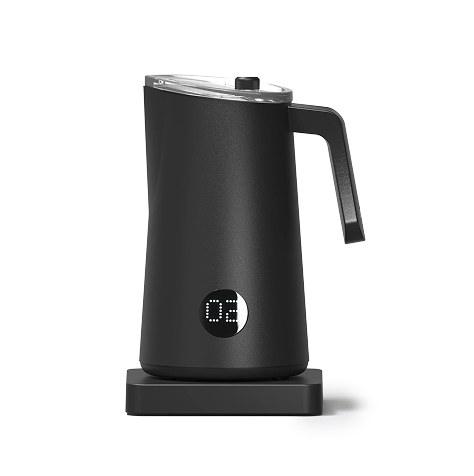
Unlock the secret to velvety-smooth, café-style microfoam—without the espresso machine. The NanoFoamer PRO GEN-2 is the ultimate hands-free microfoam maker, designed for coffee lovers who want professional results at home, fast and effortlessly. Whether you're using dairy or plant-based milk, this precision-engineered device transforms your morning routine into a café-quality experience.
Why You’ll Love It
✅ Automatic & Hands-Free – Heat and foam your milk at the same time you're pulling your shot.
✅ Barista-Level Microfoam – Create rich, silky microfoam perfect for latte art.
✅ Works with All Milks – Dairy, oat, almond, soy—thanks to 3 optimized flow controllers.
✅ 5 Custom Programs – Tailor foam thickness and temperature to your drink of choice.
✅ Whisper-Quiet – Smooth operation with magnetic impeller height adjustment for perfect vortex control.
✅ Easy to Clean – IPX-5 water-resistant. Rinse it under the tap—no fuss.
✅ Portable & Sleek – Compact design that fits any kitchen setup.
What’s Included
- NanoFoamer PRO GEN-2 (EU Plug - 220V)
- 3 Flow Controllers (Black for dairy, Blue/Green for plant-based milks)
- Impeller height adjuster
- Free Latte Art MasterClass
- 30-Day Guarantee
- 1-Year Limited Warranty
Product Specs
- Dimensions: 12 × 12 × 20 cm
- Weight: 800g
- Power: 400W
-
Voltage: 220V (EU Plug)
-
Capacity: 100–220 ml
-
Water Resistance: IPX-5
-
Cord Length: 70 cm
The NanoFoamer PRO Gen-2 is engineered for perfectionists, busy mornings, and passionate home baristas alike. Ditch the noisy steam wands and inconsistent frothers—Subminimal brings you microfoam that rivals your favorite café, right at home.
NanoFoamer

Description (NanoFoamer):
Create silky, café-style microfoam in seconds with the Subminimal NanoFoamer – the world’s best handheld milk foamer designed for serious home baristas. Whether you’re perfecting a cappuccino, crafting a creamy flat white, or elevating your matcha latte, the NanoFoamer delivers superfine microfoam worthy of any coffeehouse.
Why NanoFoamer?
-
True Microfoam Technology – Unlike standard frothers, the NanoFoamer creates invisible microbubbles that result in smooth, velvet-like milk – perfect for latte art.
-
Battery or Rechargeable Options – Choose between the V2 (AA battery-powered) or the upgraded Lithium (USB-C rechargeable) model with dual-speed settings.
-
Compatible with Dairy & Milk Alternatives – Designed to work beautifully with barista-style oat, almond, soy, or dairy milks.
-
Easy to Use, Easier to Clean – Waterproof and intuitive, with upgraded clip-on NanoScreens and a replaceable polycarbonate impeller for durability and performance.
What’s Included:
-
NanoFoamer (V2 or Lithium)
-
2 NanoScreens: Fine & Superfine
-
Protective Hood
-
Wall Mount
-
Free Latte Art Masterclass
Technical Specs:
|
Feature |
V2 |
Lithium |
|
Power |
2 × AA Batteries |
USB-C Rechargeable (1300mAh) |
|
Speed |
3,000 RPM |
Dual Speed: 3,000 & 4,000 RPM |
|
Weight |
104g |
135g |
|
Waterproof |
✅ |
✅ |
|
NanoScreens |
Fine & Superfine |
Fine & Superfine |
|
Impeller |
Replaceable Polycarbonate |
Replaceable Polycarbonate |
Discover Subminimal products and elevate every drink.
Discover Also:
2) Instant MagicFroth 9-in-1

Description:
This countertop electric milk frother from Instant Brands delivers impressive versatility for home coffee enthusiasts seeking café-level results without complexity. It combines three temperature options including cold, warm around 140 degrees Fahrenheit, and hot up to 165 degrees Fahrenheit with three foam textures ranging from simple stirring to dense latte foam or airy cappuccino style, creating nine customizable combinations. The 17-ounce stainless steel pitcher handles one to two servings of thick foam or up to 500 milliliters when heating only, and its detachable design plus magnetic whisk make setup and storage effortless.
In testing it produced dense microbubble-rich foam that holds structure well across dairy whole or two percent milk as well as oat and almond alternatives, while blending cocoa or chocolate chips smoothly without clumping. Cycles run about four to five minutes, the unit stays quiet and compact at roughly 6.5 by 4.2 by 6 inches and 2.2 pounds, and the dishwasher-safe pitcher simplifies cleanup. Affordable under fifty dollars in many USA markets with a one-year warranty, it excels for daily lattes, iced cold foam, and flavored drinks, though the pitcher exterior heats up and thicker foam batches stay modest. Its multi-function approach fits the 2026 preference for efficient, space-saving kitchen tools that replace multiple gadgets while delivering pourable velvety foam suitable for latte art.
Cons are minor: the stainless steel gets hot to the touch during use, requiring careful handling, and it's not the fastest for quick mornings, plus it's limited to smaller batches for ultra-thick foam. For coffee specifically, it's recommended because it mimics professional espresso machine results at home, enabling latte art with its pourable, velvety foam, and supports the 2026 trend toward multi-functional kitchen gadgets for sustainable, cost-effective home brewing—perfect for USA consumers who want barista-level drinks without a full espresso setup.
3) Nespresso Aeroccino 4

Description:
Nespresso Aeroccino 4 offers a slim metallic countertop design that pairs perfectly with Nespresso systems or works independently, featuring four one-touch settings for hot dense foam ideal for lattes, hot airy foam suited to cappuccinos, hot milk without foam for flat whites, and cold foam perfect for iced coffee. The eight-ounce frothing capacity or four ounces for denser results self-heats milk evenly, finishing cycles in just one to two minutes while producing tight-bubble luscious foam with excellent mouthfeel that pours smoothly for latte art. It handles dairy for creamy textures and plant-based options like oat milk reliably, and incorporates matcha or cocoa powders cleanly without residue.
Measuring about 4.09 by 7.48 inches and weighing 1.9 pounds, the narrow profile saves counter space, includes a comfortable handle and sharp spout for precise pouring, and offers fully dishwasher-safe parts including the magnetized whisk. Quiet and efficient with a premium two-year warranty, it typically retails around 100 to 120 dollars yet frequently appears on sale at major USA retailers. Minor drawbacks include the single-serving limit, potential for scorching if overfilled on the hottest setting, and a higher price point, but its consistent barista-quality performance and compact reliability make it a favorite for daily personalized brewing and small-kitchen setups in 2026.
Pros abound: compact footprint for small USA kitchens, quiet and efficient operation, versatile for both hot and cold beverages, and a premium build from a trusted coffee brand with a two-year warranty, often priced around $100-120 but frequently on sale at USA sites like Amazon or Best Buy.
Cons include a smaller capacity limiting it to single servings, a tendency to scorch on the hottest setting if overfilled, and a higher price point that might not suit budgets, plus the narrow opening can make hand-cleaning tricky if not using a dishwasher. For coffee enthusiasts, it's highly recommended due to its barista-like results in replicating café drinks at home, supporting the 2026 shift toward compact, high-end appliances for personalized brewing, and its compatibility with pod systems—users rave about its reliability over the years, making it a staple for daily lattes or entertaining.
4) Breville Milk Cafe

Description:
The Breville Milk Cafe stands as a premium countertop electric frother built for precision and larger batches, featuring an adjustable temperature dial from 100 degrees Fahrenheit to over 160 degrees Fahrenheit with a cold setting plus two interchangeable whisks: one for dense silky latte foam and one for airier cappuccino volume. Its tapered stainless steel pitcher creates a powerful vortex that yields superior microfoam texture integrating seamlessly into espresso, while the generous 25-ounce capacity supports multiple servings or family use.
Dimensions of 7.5 by 6.4 by 10.4 inches and a weight of 3.6 pounds include handy cord storage and a magnetic whisk holder, with the dishwasher-safe pitcher pouring cleanly without drips. Testing confirms even heating without burning, excellent results with almond and other non-dairy milks, and effortless incorporation of vanilla or chocolate flavors, with cycles lasting three to five minutes. Quiet operation, sturdy construction, and a one-year warranty justify the 150 to 200 dollar investment often found at Williams Sonoma or Amazon. Though bulkier for tiny counters and requiring some whisk experimentation for ideal results, its unmatched customization for exact foam consistency and temperature control positions it as a strong upgrade for serious home baristas pursuing professional-level drinks and entertaining in 2026.
Pros include unmatched customization for coffee purists, quiet operation, sturdy build with a one-year warranty, and versatility for hot chocolate or matcha, making it a worthwhile investment, often around $150-200 in USA markets like Williams Sonoma or Amazon. Cons are its higher price tag and bulkier size, which may not fit tiny counters, plus it requires experimenting with whisks for best results. It's recommended as an upgrade for serious coffee makers in 2026, aligning with trends in customizable home brewing for exact foam consistency and temperature control, enabling professional-level drinks without a full machine. Experts note its longevity and performance make it ideal for daily use or entertaining.
5) Golde Superwhisk

Description:
The Golde Superwhisk is a rechargeable handheld electric frother from the wellness brand that prioritizes speed and power in a compact form, delivering two high-speed settings with a dual-coiled metal head that produces thick airy microfoam in under 15 seconds from pre-warmed or cold milk. Weighing just 4.55 ounces and measuring around 10 inches long, it includes a USB charger, detachable dishwasher-safe whisk, and cylindrical protective cap for travel or storage, offering sturdy daily-use construction. Evaluations praise its voluminous silky foam that holds shape well for lattes and disperses evenly in cappuccinos, performing strongly with dairy for richness and coconut or similar alternatives, while blending matcha or protein powders smoothly without lumps.
The ergonomic design feels comfortable, recharging eliminates battery hassles, operation stays quiet, and a two-year warranty supports the affordable 20 to 30 dollar price common at Target or Amazon. It can over-froth into stiff peaks if left too long and may stutter slightly with very thick milks, yet its rapid performance and portability shine for busy mornings, small batches, or on-the-go iced and hot drinks. In 2026 this model supports the growing wellness-coffee crossover by making high-quality frothing accessible and versatile without countertop bulk.
Pros: Super-fast and powerful performance, comfortable ergonomic design, battery-free recharging for convenience, quiet operation, and a two-year warranty, priced affordably at $20-30 in USA outlets like Target or Amazon.
Cons: Heavier than basic models, easy to over-froth into stiff peaks, and no returns policy (only replacements), plus it may stutter slightly with very thick milks. It's recommended for coffee as a budget handheld powerhouse in 2026, supporting quick, on-the-go frothing for iced or hot drinks amid rising wellness-coffee crossovers—users love its versatility for small batches and portability.
6. Capresso Froth Pro
The Capresso Froth Pro is an automatic electric milk frother designed for home use with a focus on consistent frothing and heating. Manufactured for the USA market under Capresso, part of the Jura group with operations supporting North American distribution, it features a stainless steel exterior and a non-stick pitcher. The unit operates with three illuminated temperature settings for cold, warm, and hot milk, using interchangeable disks for frothing or heating only.
It produces frothed milk for cappuccinos and lattes while also handling non-dairy options such as soy or almond milk. Dual auto shut-off activates when the set temperature is reached or if the pitcher is lifted from the base. The design includes a cool-touch handle and a see-through lid. Cycles complete with automatic stop for safety, and the pitcher is dishwasher-safe for straightforward maintenance after daily coffee preparation.
-
Key features: 600W heating system, three temperature buttons (cold/hot/warm), two frothing disks and one heating disk stored magnetically under the base, scratch-resistant non-stick pitcher, dual auto shut-off, cool-touch handle.
-
Accurate data and information: Capacity of 8 oz for frothed milk and 12 oz for heated non-frothed milk, dimensions 6.75 x 5 x 7 inches, weight 3 lbs, 120V/60Hz, UL listed, works with dairy and plant-based milks, 1-year limited household warranty, produces creamy foam suitable for cappuccino and latte textures.
7. Smeg MFF01
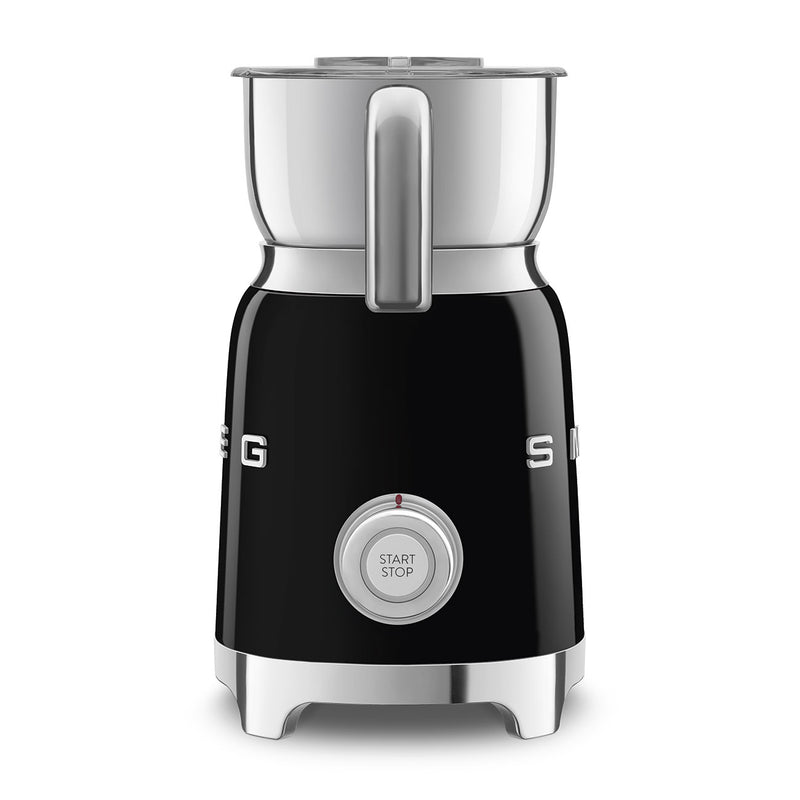
The Smeg MFF01 is a retro-style automatic milk frother from the Italian brand Smeg, headquartered in Guastalla, Italy, and widely available across USA retailers for home kitchens. It combines heating and frothing functions with six pre-set programs plus a manual option to create hot or cold foam for cappuccinos, flat whites, lattes, and hot chocolate. The unit includes two whisks, one notched for frothing and one flat for heating, delivering thick creamy results from dairy or plant-based milks.
A transparent lid with measuring markings aids precise filling, while the stainless steel body maintains a classic 1950s aesthetic. Operation is straightforward with one-touch controls that auto-stop when finished. The frother supports both single servings and slightly larger batches depending on the selected program, making it suitable for daily café-style drinks without requiring an espresso machine steam wand.
-
Key features: Six pre-set programs and manual function, two whisks (notched and flat), hot and cold foam options with or without foam, stainless steel construction, transparent lid with measuring cup, auto shut-off.
-
Accurate data and information: Maximum capacity 500 ml for heating or 250 ml for frothing, dimensions approximately 6 x 10 inches, weight around 2.29 kg, 500W motor, produces thick smooth foam for cappuccino latte macchiato and hot chocolate, dishwasher-safe whisks, designed for dairy and alternative milks.
8. Secura Automatic Milk Frother

Secura Automatic Milk Frother is a 4-in-1 electric model popular in the USA for versatile hot and cold foam production, with the company based in the United States. It heats and froths milk for lattes, cappuccinos, macchiatos, and hot chocolate using multiple whisks including options for dense foam, airy foam, and heating only. The stainless steel pitcher detaches easily, and silicone spatula is often included for scraping.
Temperature reaches approximately 150°F for hot settings while cold foam remains unheated. The unit features clear max and min fill lines to prevent overflow and supports whole milk for optimal texture as well as many plant-based alternatives. Auto shut-off ensures safe operation after the cycle completes, typically within one to two minutes depending on volume. The compact base allows countertop placement in standard kitchens.
-
Key features: 4-in-1 functions (hot dense foam, hot airy foam, cold foam, heat only), three whisks, detachable stainless steel pitcher, silicone spatula, max/min level indicators, auto shut-off.
-
Accurate data and information: Capacity 8.5 oz / 250 ml for frothing and 17 oz / 500 ml for heating, dimensions about 6.1 x 7.2 inches, frothing time 60-90 seconds, works with dairy and non-dairy milks, ETL certified for North American standards, 2-year warranty on many models.
9. Bodum Bistro Electric Milk Frother
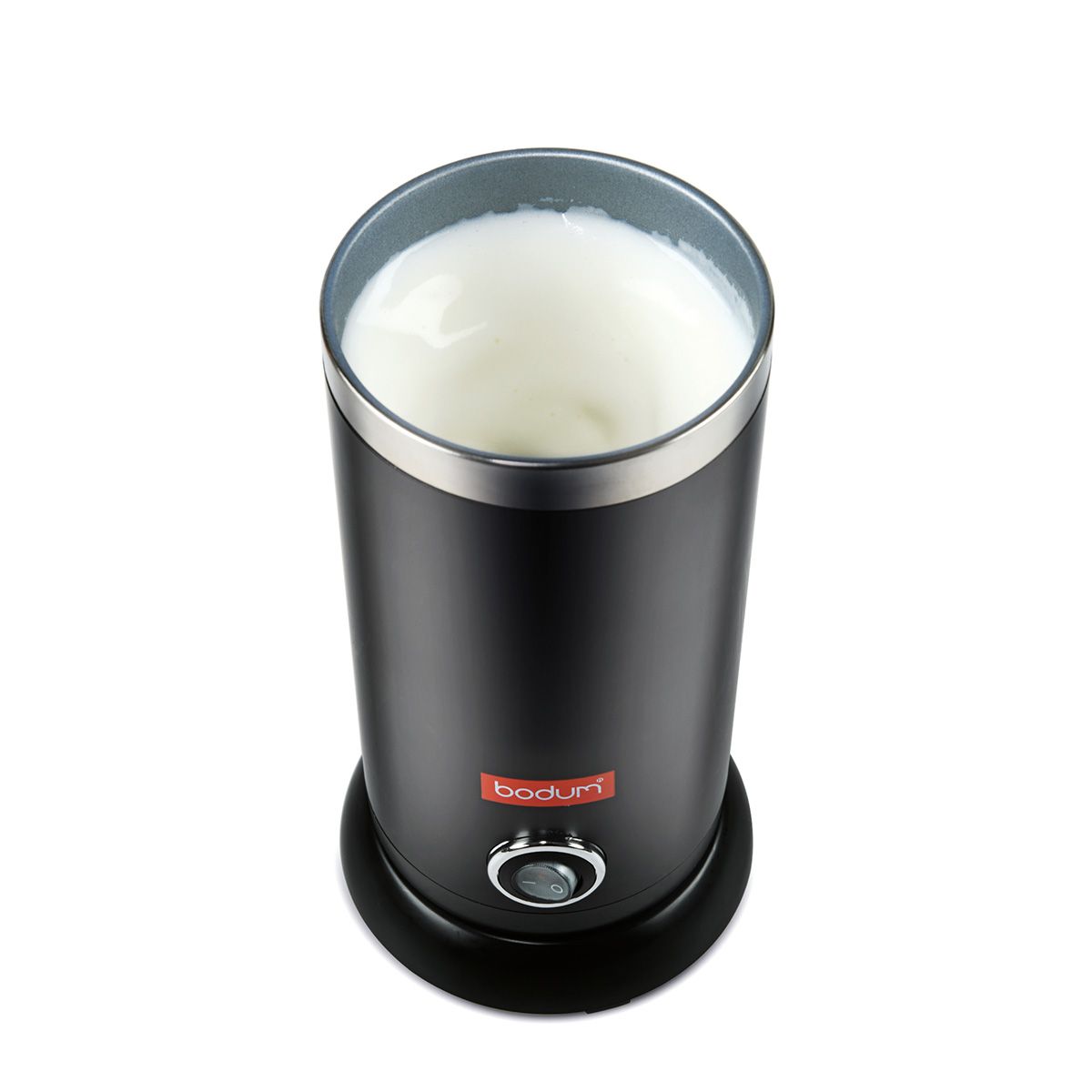
The Bodum Bistro Electric Milk Frother comes from the Danish brand Bodum, headquartered in Triengen, Switzerland, and sold extensively in USA stores. This compact automatic unit heats and froths milk in a single cycle for cappuccinos and lattes, with a transparent lid that lets users monitor the process. It includes a stainless steel pitcher and produces airy foam suitable for both dairy and oat or almond milks.
The design focuses on simplicity with one-button operation and automatic shut-off once the milk reaches the proper temperature and texture. Capacity supports single cups efficiently, and the frother works as a standalone appliance next to any coffee maker. Cycles finish in roughly one minute, after which the pitcher can be hand-washed or wiped clean. Its sleek black or colored exterior fits modern kitchen counters without taking excessive space.
-
Key features: Automatic heat and froth cycle, transparent lid, stainless steel construction, auto shut-off, one-button operation, suitable for dairy and plant-based milks.
-
Accurate data and information: Capacity 10 oz / 300 ml for heating and frothing, power 500W, dimensions compact for countertop use, cycle time about 60 seconds, produces warm airy froth, hand-wash recommended for pitcher, available in multiple colors.
10. PowerLix Milk Frother
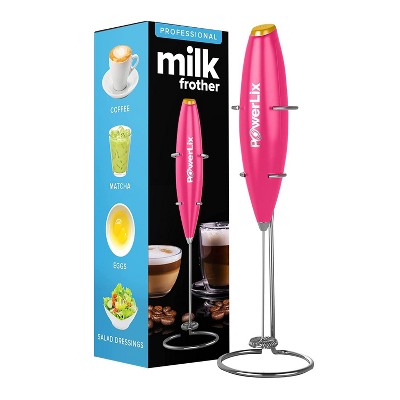
PowerLix Milk Frother is a handheld battery-operated wand widely distributed in the USA for quick portable frothing. It uses a powerful motor and double stainless steel spiral whisk to create foam for coffee, lattes, matcha, and protein drinks. The ergonomic soft-touch handle provides comfortable grip during use, and the unit often includes a stand or foamer cup for storage and mixing.
Operation is simple with a single button that activates high-speed rotation. The whisk is long enough to reach the bottom of most mugs and resists rust. Battery power from two AA cells allows cordless freedom anywhere in the kitchen or for travel. Foam forms in 15 to 20 seconds depending on milk volume and type, working effectively with cold or pre-warmed dairy and non-dairy options.
-
Key features: Handheld design, double spring stainless steel whisk, ergonomic soft-touch handle, battery operated (2 AA), included stand or foamer cup (BPA-free, microwave and dishwasher safe on cup versions), high-speed motor.
-
Accurate data and information: Motor speed 19,000 RPM, frothing time 15-20 seconds, weight 0.35 pounds, capacity up to 10 oz / 300 ml when used with included cup, 18/10 food-grade stainless steel whisk, multifunctional for coffee shakes and egg whisking.
11. Dreo BaristaMaker

Dreo, a consumer appliance brand with a strong United States retail presence, built the BaristaMaker as a countertop jug that tries to copy steam-wand texture without an espresso machine. You pick the milk type first, dairy, half and half, oat, soy, almond, or coconut, then choose a drink style such as flat white, latte, cappuccino, hot thick foam, or cold thick foam. An impeller tip pulls milk into the center while a micro screen breaks large bubbles. Stir mode warms powders for cocoa and protein drinks and lets you set heat in steps up to about 170 F. Cycles take around three and a half minutes. The stainless jug is dishwasher safe and marked with min, latte-art, max foam, and max stir lines so fill volume stays consistent.
-
Key features: LCD panel with milk-type and drink presets, interchangeable impeller and disc tips, dual temperature sensors, stir mode for powders, auto shut-off, 600 W US version, stainless steel jug with no interior coating.
-
Accurate data and information: Maximum frothing capacity 8.5 oz (250 ml), minimum frothing 5.1 oz (150 ml), maximum stirring 15.2 oz (450 ml). Assembled size about 4.93 x 4.93 x 9.21 inches and 2.56 lb. Froth-mode heat typically lands between 140 F and 158 F depending on the milk preset.
12. Zulay Kitchen Handheld Milk Frother
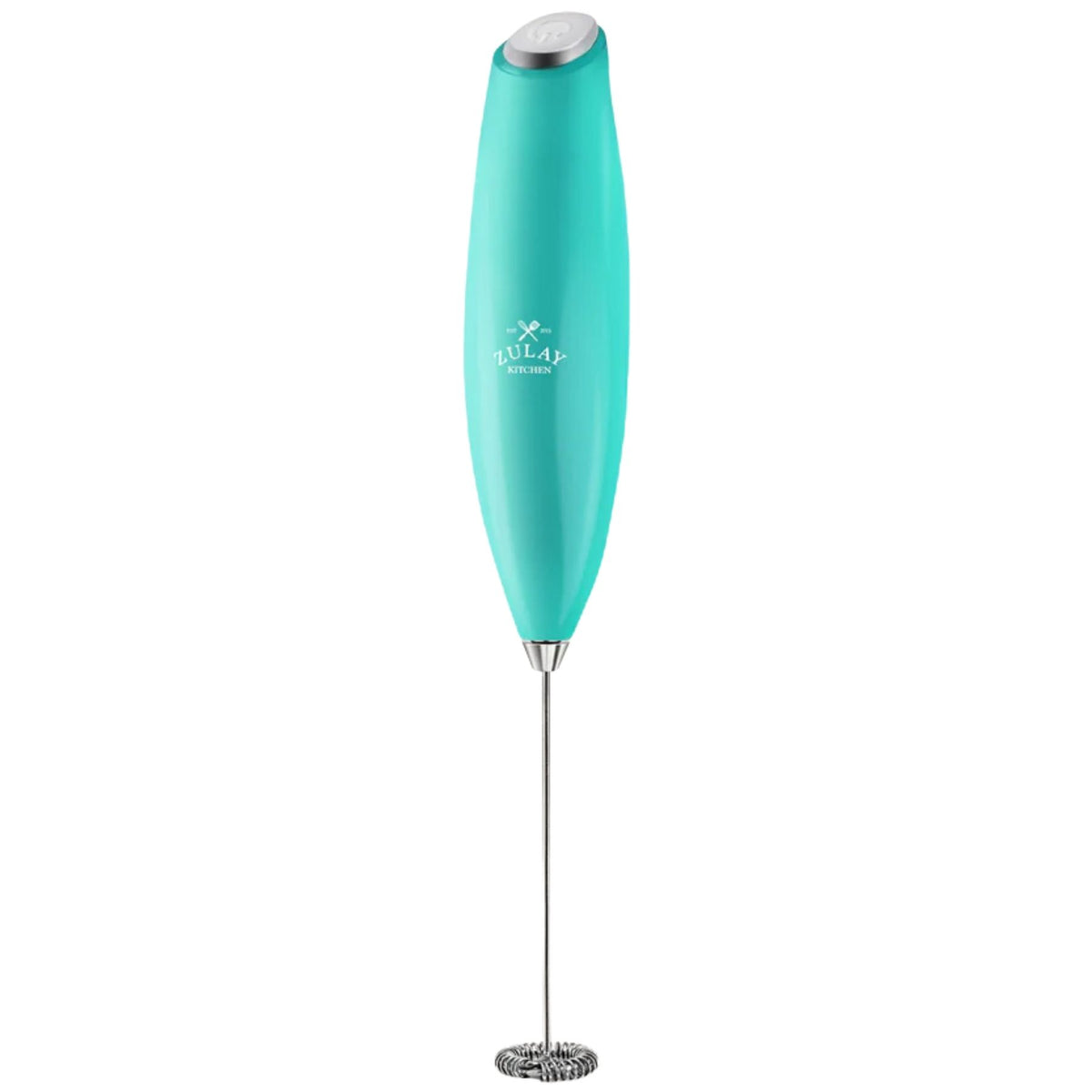
Zulay Kitchen, based in Florida, sells one of the highest-volume handheld wands in the United States. The classic model uses two AA batteries and a stainless spiral whisk that spins near 13,000 RPM to foam dairy, oat, almond, soy, and creamers in about 15 seconds. It does not heat milk. A one-touch button keeps operation simple, and many kits include a counter stand plus Duracell cells in the box. The whisk rinses under the tap while the handle is wiped dry. The brand also offers USB-C versions with extra whisks for eggs and denser foam. Across Amazon milk-frother rankings the battery wand regularly sits at or near the top, with hundreds of thousands of ratings, which makes it a default first frother for matcha, protein drinks, and everyday lattes.
-
Key features: Battery or USB-C variants, one-touch control, stainless spiral whisk, optional stand, lifetime limited warranty on eligible models, BPA-free handle, works with hot or cold milk after you heat separately.
-
Accurate data and information: Typical length about 9.75 inches and weight around 0.2 to 0.4 lb. Motor speed commonly listed at 13,000 RPM. Best-seller listings show well over 200,000 customer reviews on the core wand family and monthly unit sales in the tens of thousands in the US category.
13. Maestri House DualFro 400
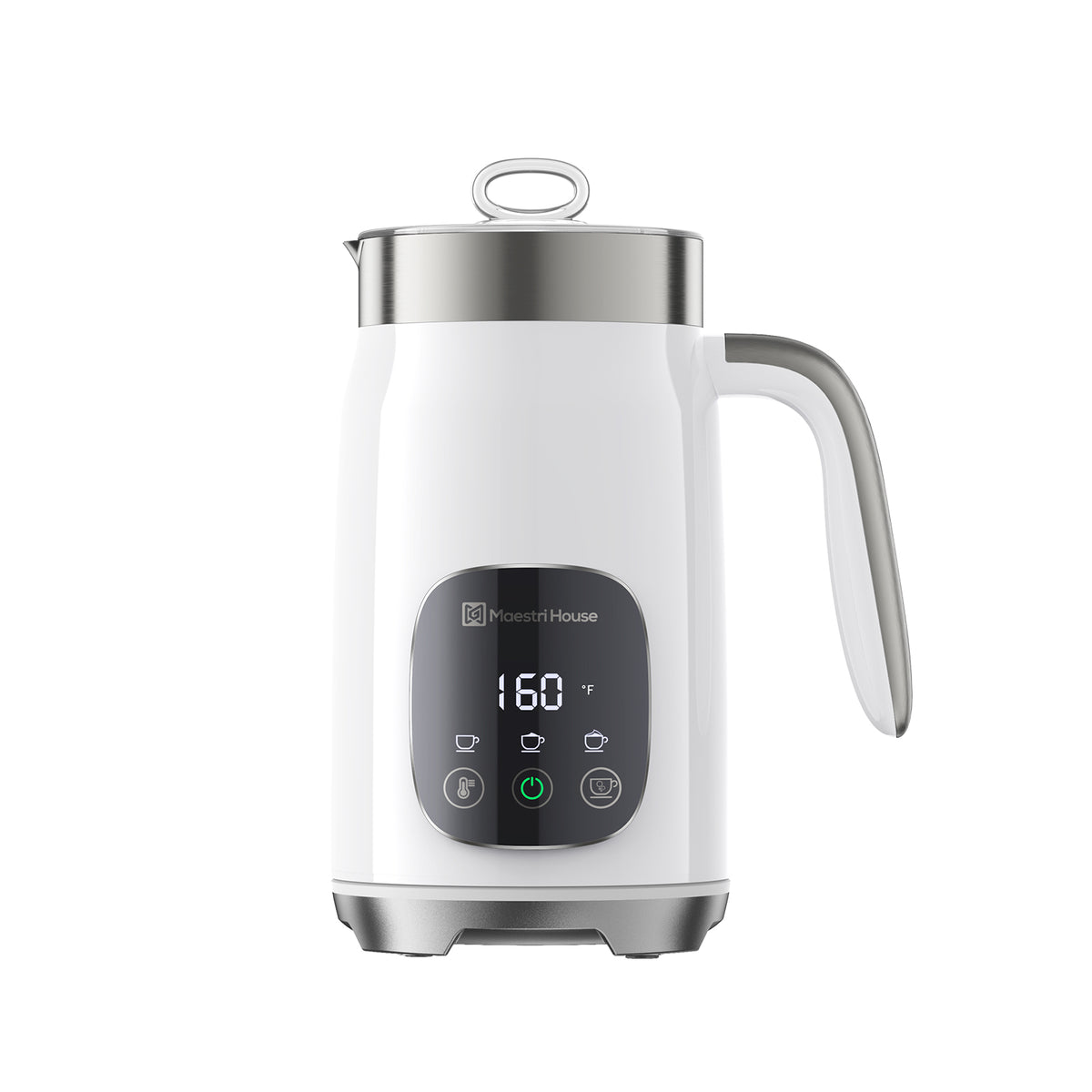
Maestri House focuses on customizable home frothers sold widely through US marketplaces. The DualFro 400 is an integrated 500 W jug with four temperature points, room temperature, 120 F, 140 F, and 160 F, plus low, medium, and high foam density. Six touch modes cover cold froth, cold airy froth, hot froth, hot airy froth, hot milk, and hot chocolate. A memory function recalls the last program. The stainless interior is nonstick, with overheat protection and clear min and max lines. You can foam about 200 ml or heat about 400 ml, enough for one to two drinks. The unit is quieter than many budget jugs and uses a compact touch panel rather than a mechanical dial. It is aimed at households that want temperature control without stepping up to a large induction pitcher.
-
Key features: Variable temperature and foam thickness, six touch programs, memory function, nonstick interior, overheat protection, magnetic whisks, 120 V operation for North America.
-
Accurate data and information: Heating capacity 14.1 oz (400 ml), maximum foam 7.0 oz (200 ml), minimum foam 3.5 oz (100 ml). Power 500 W. Packaged weight about 2.53 lb. Typical package dimensions near 8.9 x 6.85 x 6.81 inches.
14. SIMPLETASTE 4-in-1 Electric Milk Frother

SIMPLETASTE is a high-volume Amazon house brand whose 4-in-1 jug is a frequent US best seller in the automatic category. One button cycles through warm dense foam, warm airy foam, heat-only milk, and cold foam, with a color LED showing the selected mode. A 500 W heater and magnetic whisk sit in a nonstick chamber with a detachable base. Auto shut-off and dry-burn protection stop the cycle when the program ends. Capacity is modest, about 115 ml for foam and 240 ml for heating on common SKUs, so it is sized for one or two cups. Whole milk above 3 percent fat is the official recommendation for thicker foam. The jug is generally hand-wash only. The formula is familiar, yet the ranking persistence shows how many US shoppers start with a small, one-button steamer rather than a handheld wand.
-
Key features: Four one-button programs, LED mode colors, nonstick interior, removable whisk, detachable base, auto shut-off, overheat protection, spare whisk in many boxes.
-
Accurate data and information: Common capacities 115 ml (3.9 oz) frothing and 240 ml (8.2 oz) heating. Heat-only cycles about 150 to 250 seconds, foam cycles about 80 to 140 seconds, cold foam about 55 to 60 seconds. Item weight often listed near 1.7 to 1.85 lb.
15. Aerolatte Original Steam-Free Milk Frother

Aerolatte, founded in 1999 and headquartered in Radlett, United Kingdom, created the category of battery steam-free wands and still sells the Original widely in the United States. The satin or chrome stick uses two AA cells and an 18/8 stainless spiral head to foam dairy and plant milks in roughly 20 to 60 seconds. It does not heat. Founders Alan Green and Gary Lane designed it after deciding steam machines were the wrong tool for home cappuccino. The housing is BPA-free plastic, batteries are included, and a stand or storage tube appears on many SKUs. Nigella Lawson helped popularize the wand with home cooks. The head is not removable on the classic model, so cleaning is a rinse and wipe. It remains the reference design that later US budget wands copied.
-
Key features: Steam-free handheld design, 18/8 stainless whisk and shaft, two AA batteries included, works with dairy and plant milks, optional counter stand, long manufacturer guarantee on the Original.
-
Accurate data and information: Typical size about 8.5 x 1.5 inches. Batteries are rated for around 150 uses. Company founded in 1999 in the UK. US listings specify lead, cadmium, phthalate, and BPA-free construction.
16. Cuisinart Hot/Cold Foam Milk Frother
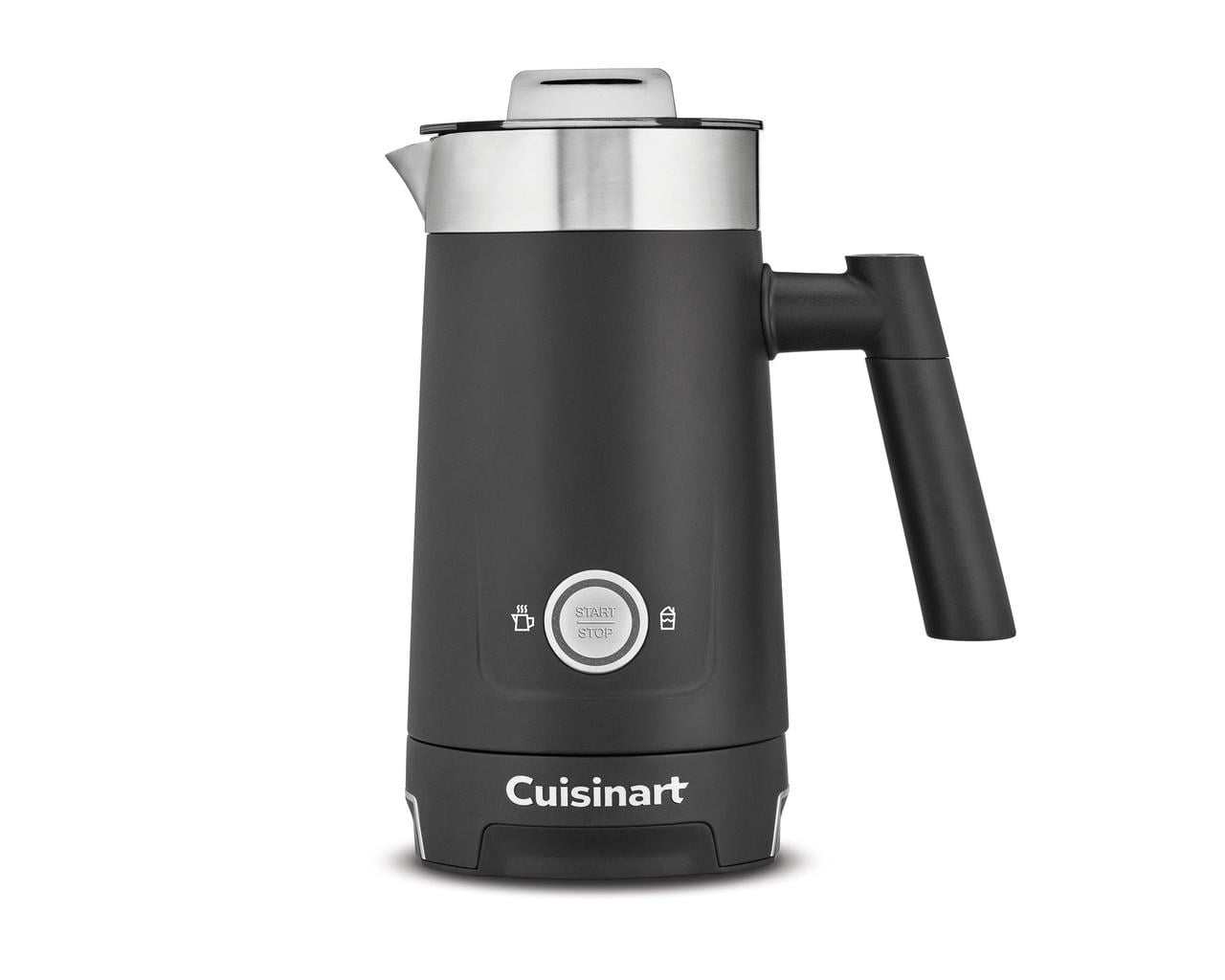
Cuisinart, based in Stamford, Connecticut, sells the FR-16 as a compact jug for kitchens that already own the brand’s grinders and kettles. A single control cycles hot foam, cold foam, or warmed milk. The spring whisk builds a cap for lattes and cappuccinos. Remove that spring and the same shaft stirs milk without adding much air, which suits flat whites and cocoa. Capacity stays personal: about 4 ounces of foam or 8 ounces of heated milk, so it is a one-cup tool rather than a brunch pitcher. The stainless tank is nonstick, the lid is dishwasher safe, and the cool-touch shell plus pour spout help with a clean stream. Guardian testers found the two-mode layout simpler than multi-program jugs, with foam that is usable if not as tight as higher-end induction models. UL listing and a three-year limited warranty place it in the mid-tier appliance aisle at Target, Macy’s, and Cuisinart’s own shop.
-
Key features: One-button hot foam, cold foam, and heat-only modes. Interchangeable frothing whisk and milk-warming stirrer. Nonstick stainless tank, cool-touch exterior, grip handle, and integrated spout. Dishwasher-safe lid. 460 W heater. 3-year limited warranty.
-
Accurate data and information: Foam capacity up to 4 oz. Heating capacity up to 8 oz. Dimensions about 6.69 x 4.25 x 8.5 inches. Weight about 1.88 lb. Sold through U.S. housewares retailers as model FR-16.
17. Hamilton Beach Milk Frother and Warmer
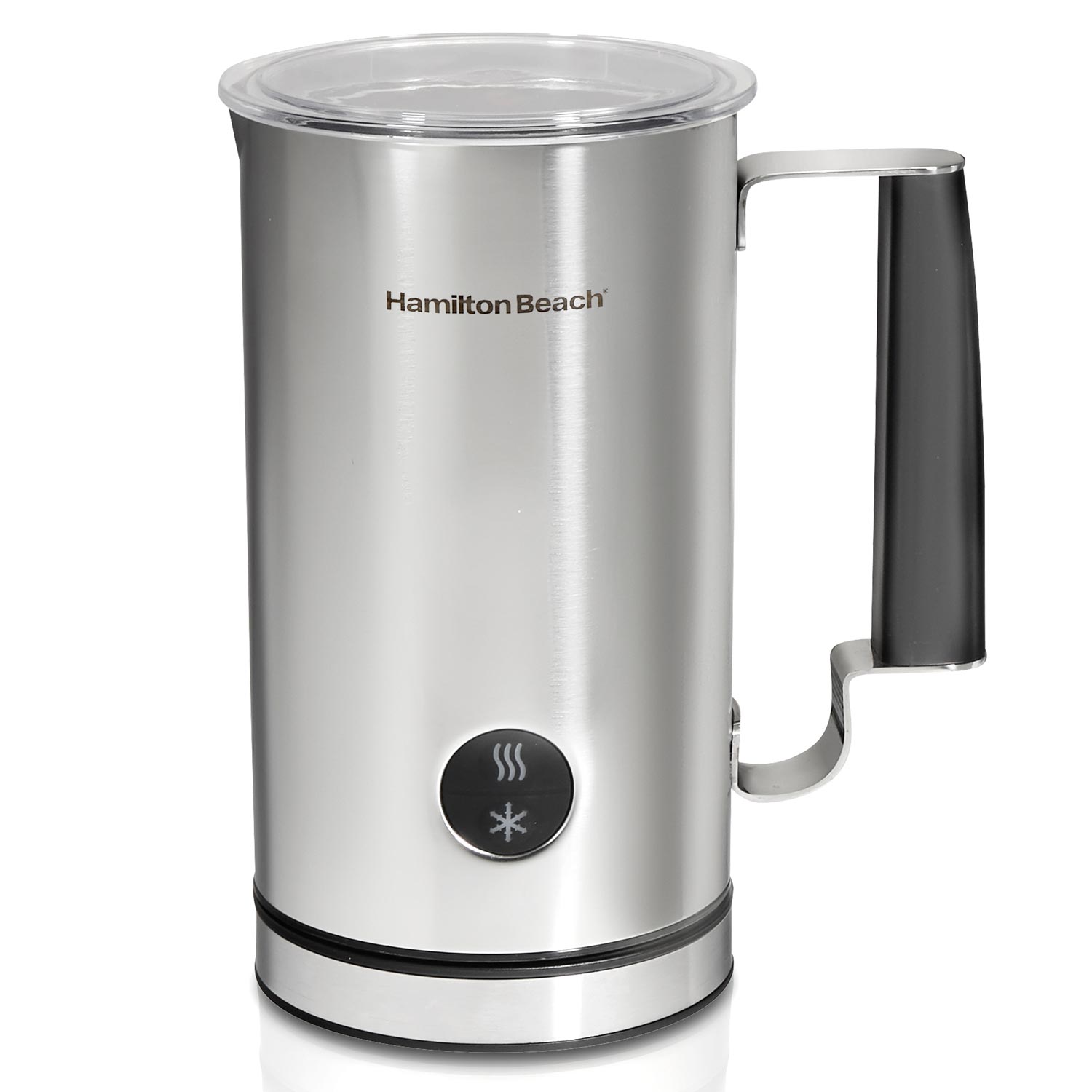
Hamilton Beach, headquartered in Glen Allen, Virginia, makes the 43565C as a stainless 4-setting jug for everyday lattes rather than latte-art practice. Thick foam, thin foam, cold foam, and heat-only cover cappuccino, café au lait, iced drinks, and plain steamed milk. The pitcher lifts off a cordless base when the cycle ends, and auto shut-off cuts power as soon as you pick it up. Foam is ready in about two minutes. Warming finishes in under three. Fill marks inside a nonstick chamber keep 150 ml of froth or 300 ml of heated milk from overflowing. The clear lid lets you watch the rise. It is a department-store appliance with a modest footprint (about 8.1 x 6.2 x 4.3 inches) and a finish that matches other Hamilton Beach stainless tools. Texture is airy café foam more than wet microfoam, which fits households that want a button, not a steam class.
-
Key features: Four settings for thick foam, thin foam, cold foam, and warmed milk. Cordless serving jug with auto shut-off. Nonstick interior with fill marks. Clear lid. Removable whisk. Stainless exterior.
-
Accurate data and information: Froth capacity 150 ml (5 oz). Heating capacity 300 ml (10 oz). Foam cycle under 2 minutes. Heat cycle under 3 minutes. Model 43565C. Dimensions about 8.1 x 6.2 x 4.3 inches. U.S. 120 V household unit.
18. Hotel Chocolat Velvetiser
![[CHÍNH HÃNG] Máy đánh sữa Delonghi Alicia EMF2 - Delonghi Alicia EMF2.W - Delonghi Alicia EMF2.BK - Electric Milk Frother Delonghi Alicia Latte EMF2](https://product.hstatic.net/1000360575/product/may-danh-sua-delonghi-alicia-emf2_d789018717f1475193632948bbbd00b6.png)
Hotel Chocolat, based in St Albans, United Kingdom, sells the Velvetiser through its U.S. shop as a single-serve chocolate and milk mixer rather than a classic cappuccino jug. A petal whisk and patented InnerPod ridges create a vortex that folds flakes or sachets into dairy or plant milk. Hot mode lands around 155 to 158 F, the range the brand uses to melt real chocolate without scorching. Cold mode pulses first so chilled milk and finely milled chocolate combine without a grainy layer. A cycle lasts about 2.5 minutes and yields one 8 to 10 ounce drink. Testers at Trusted Reviews and BBC Good Food treat it as a drinking-chocolate specialist that also handles latte sachets. Capacity is smaller than family jugs, and the ritual is built around Hotel Chocolat’s own flakes. A 24-month limited warranty covers the U.S. unit. Weight is about 2.15 lb, so it sits on a counter without dominating the station.
-
Key features: Hot and cold vortex programs. Petal whisk plus InnerPod ridges. Magnetic whisk. Fill-line jug for one serving. Works with dairy and plant milks. 24-month limited warranty on U.S. models.
-
Accurate data and information: Capacity about 10 oz (one serving). Hot finish about 155 to 158 F. Cycle time about 2.5 minutes. Unit size about 7.25 x 6.5 x 5 inches. Boxed weight about 5.3 lb. Unit weight about 2.15 lb.
19. De’Longhi Alicia EMF2
De’Longhi, headquartered in Treviso, Italy, ships the Alicia EMF2 to U.S. 120 V kitchens as a compact companion to its pump espresso machines. One button covers hot frothed milk (steady red LED), hot milk without foam (flashing red), and cold froth (blue LED held for a few seconds). The nonstick jug lifts off a 360-degree base. A drop-in whisk pops out for rinsing. You watch the swirl through a transparent lid. Frothing tops out around 140 ml and warming around 250 ml, so it is sized for one or two small drinks. A cycle runs about 2.5 minutes on 500 W. The jug is hand-wash only. Plastic housing keeps weight near 0.84 kg. Cold foam and hot foam are both available, which matters for iced lattes beside a Dedica or similar machine. Fill lines inside the pitcher keep overflow down if you start with fridge-cold milk as the manual asks.
-
Key features: Hot froth, hot milk, and cold froth on one button with LED colors. 360-degree detachable base. Removable whisk. Transparent lid. Nonstick jug. Lift-off interrupt.
-
Accurate data and information: U.S. rating 120 V, 60 Hz, 500 W. Frothing capacity about 4.7 oz (140 ml). Warming capacity about 8.4 oz (250 ml). Size about 118 x 199 x 168 mm. Cord about 0.75 m. Weight about 0.84 kg. Cycle about 2.5 minutes. Model EMF2BK in the Alicia line.
20. Melitta Cremio
Melitta, based in Minden, Germany, designed the Cremio for fine-pored foam on whole, soy, oat, and lactose-free milk. CoolTouch walls stay safe to hold while the nonstick bowl works. One-touch lights select hot froth, cold froth, or warm milk. Fill marks guide 100 to 150 ml for foam and 100 to 250 ml for heating. A 360-degree base, lift shut-off, and auto-off with overheat protection are standard. The lid and whisk are dishwasher safe. Melitta quotes about 2 to 3 minutes per batch and a max output near 450 to 500 W on current Cremio and Cremio II units, with some earlier listings at 600 W. Good Housekeeping UK has used the Cremio as a daily driver for skim and plant cartons because protein still sets a stable cap. The bowl is smaller than 16 ounce family jugs. A 2-year warranty is listed on Melitta international pages. Cord wrap hides in the base.
-
Key features: Hot froth, cold froth, and warm milk. CoolTouch exterior. Nonstick bowl. Dishwasher-safe lid and whisk. 360-degree base. Lift shut-off and auto-off. Cable storage.
-
Accurate data and information: Foam range 100 to 150 ml. Heat range 100 to 250 ml. Cycle about 2 to 3 minutes. Max output commonly 450 to 500 W (some older SKUs 600 W). Standby under 1 W. Typical size near 16.5 x 11 x 21 cm on Cremio II. 2-year warranty on Melitta pages.
Discover the best milk frother for coffee in 2026 - Subminimal
Best Milk Frother for Latte Art in 2026
True latte art needs microfoam. That means milk with tiny, even bubbles that look shiny like wet paint. Big bubbles ruin the pour. They make the foam dry and break apart. The right milk frother creates this silky texture every time so your hearts, rosettas, and tulips hold their shape.
The NanoFoamer PRO stands out for this job. Its magnetic impeller and NanoScreen spin at high speed without adding water or steam. The result is pure, undiluted microfoam that pours smoothly and is glossy. You get five programs that adjust foam thickness and temperature. The black flow controller works best for dairy. Blue and green ones handle oat and almond milks that often struggle with regular frothers.
Many home baristas also reach for the handheld NanoFoamer. It comes with two NanoScreens. The superfine screen makes the tightest microfoam for flat whites and piccolos. The fine screen gives a bit more volume for cappuccinos. Dual-speed options let you start slow, then finish with a vortex that polishes the milk.
Pair either frother with a FlowTip Milk Jug. The pointed spout and smooth neck give exact control when you pour. The free Latte Art Masterclass that comes with both frothers shows the exact pour angles and pitcher tilts that turn good foam into clean designs.
Temperature matters too. Aim for milk around 55–65°C. Too hot and the foam collapses. Too cold and the bubbles stay large. Automatic frother models with precise heat control remove the guesswork. Handheld models work best when you warm the milk first then froth.
Plant milks need extra care. Oat milk often foams well with the blue controller on the NanoFoamer PRO. Almond milk prefers the green one and a slightly lower temperature. Fresh cold milk always gives better results than room-temperature cartons.
Practice the basic free-pour moves. Start high to sink the milk into the crema. Then drop the pitcher and wiggle for patterns. The microfoam from these frothers stays liquid enough to flow yet thick enough to hold the design. That balance is what separates café-level art from regular foam.
How to Clean a Milk Frother (Every Type)
Clean milk frothers right after every use. Leftover milk dries fast and leaves a film that ruins the next batch of foam. Different frother styles need slightly different care.
Handheld electric frothers like the NanoFoamer are the simplest. Rinse the shaft and NanoScreen under warm running water as soon as you finish. The IPX-rated waterproof body lets you hold it under the tap. Wipe the handle with a damp cloth. Once a week soak the screens in warm soapy water and scrub gently with the included brush. Let everything air dry completely before putting the protective hood back on.
Automatic countertop frothers such as the NanoFoamer PRO need a bit more attention. Empty any leftover milk. Fill the jug with warm water and a drop of mild soap. Run a short rinse cycle if the model has one. Wipe the magnetic impeller and NanoScreen with a soft sponge. The non-stick ILAG coating keeps milk from sticking so most residue slides off. Dry the base with a towel so no water sits near the electronics. Once a month use a food-safe descaler if hard water is a problem in your area.
Manual pump frothers work like a French press. Take the plunger out. Wash the mesh filter and glass or metal cylinder in warm soapy water. A bottle brush reaches the bottom. Rinse well and leave the parts upside down to dry. Never leave milk sitting inside overnight.
A few extra habits keep every frother working longer. Never use steel wool or harsh scrubbers. They scratch coatings and create spots where milk can cling. Always dry metal parts fully to stop rust. Store frothers with the whisk or impeller free of pressure so the blades stay straight.
If foam starts looking thin or the motor sounds strained, check the screens and impeller for built-up milk solids. A quick deep clean usually fixes it. Regular cleaning keeps microfoam quality high and stops off-flavors from old milk. It takes less than a minute after each cup yet protects the tool for years.
How to Choose the Best Milk Frother for Your Routine
The right milk frother matches the drinks you make most days, not a long list of extra modes. A quiet weekday latte needs a different texture than a weekend flat white or a cold foam iced coffee. Start with the drink, then pick the tool shape that fits that drink.
Drink style comes first. A latte wants glossy, pourable microfoam that blends into espresso. A cappuccino wants more volume on top. A piccolo, cortado, or macchiato wants a thin, silky layer. Iced drinks want thick cold foam that sits on cold milk. Matcha wants a strong vortex that breaks powder clumps before the foam sets.
Heat is the next filter. Some kitchens already warm milk on the stove. In that setup, a handheld electric milk frother textures milk that is already hot. Other kitchens want heat and foam in one jug. That is where an electric milk frother or a compact milk steamer does both jobs. The NanoFoamer PRO heats and textures in the same cycle. The NanoFoamer and NanoFoamer GO stay in the handheld group, so milk is warmed first, then foamed.
Batch size and space matter. One cup at a time fits a wand and a small pitcher. Two drinks in a row fit a countertop jug with a clear fill window. Tiny counters favor a portable milk frother that hangs on a wall mount after use. A wider station can hold a combo frothing tool setup: frother plus FlowTip milk jug.
Milk type changes the pick. Whole dairy is the easiest path to shiny foam. Barista oat milk is the plant option that holds shape. Almond milk often needs a slower vortex and a cooler finish. Automatic units that ship with dairy and plant flow controllers handle that swap without a new machine.
Control versus one-button ease. Hands-on people like dual-speed wands and a rechargeable milk frother they can tilt in the jug. Busy mornings favor an automatic frother with set programs. Both styles still need a clean screen or impeller. Spare NanoScreens keep texture tight after months of daily use.
A simple match list:
-
Single hot latte or cappuccino: handheld NanoFoamer in a narrow jug
-
Hands-free hot foam while a shot pulls: NanoFoamer PRO
-
Travel mug, office desk, or small drawer: NanoFoamer GO
-
Pour practice and latte art: frother plus FlowTip pitcher
-
Temperature check without a probe in the milk: contactless milk thermometer
-
Espresso that actually matches the milk: Subscale for the dose and a Flick WDT tool for even grounds
Cleanup should sit in the same decision. A wand that rinses under the tap is faster on a weekday. A jug you can wipe after each cup keeps the next foam sweet. If the morning also includes puck prep, the rest of the products for coffee line sits next to the products for milk line. Shot view from an UpShot espresso mirror and milk texture from a frother are two sides of the same cup.
Best Milk for Frothing: Dairy vs Plant-Based
Fresh, cold milk makes better foam than milk that sat on the counter. Cold proteins stretch. Warm milk already sitting in a cup makes big bubbles and a dry cap. Whole dairy milk is still the easiest milk for microfoam. Fat gives shine. Protein holds the tiny bubbles. The pour looks like wet paint. That is the texture used in the latte art masterclass. Two-percent milk still foams. It just looks a little thinner. Skim milk rises fast and turns airy. Fine for a tall cap. Weak for a heart or rosetta.
Barista oat milk is the plant carton that behaves closest to dairy. Extra protein and stabilizer help the foam last through a pour. Regular oat drinks can taste slimy if they get too hot. Keep the finish in the sweet range, not scalding. Soy milk can foam well when it is fresh. Some cartons split if the heat climbs too far. Almond milk is the hard one. Low protein means large bubbles unless the vortex is tight and the milk stays cooler.
A milk frother and steamer that can change vortex shape helps here. On the NanoFoamer PRO, the black controller suits dairy. Blue is the usual start for oat and soy. Green is the slower option for stubborn almond drinks. Handheld NanoFoamer units swap a fine screen for a superfine screen when the foam looks too open.
Temperature sits in a narrow window.
-
About 55–65°C keeps sweetness and a glossy surface
-
Cooler milk keeps bigger bubbles
-
Hotter milk tastes cooked and the foam falls
A milk thermometer or the contactless thermometer checks the surface after a swirl. Do not guess from steam. Steam lies. Jug shape changes the result as much as the carton. A narrow FlowTip milk jug keeps the whirlpool tight. Wide mugs splash and leave dry foam on top. Fill only to the point where milk can rise. Overfill kills the roll.
Quick milk notes:
-
Whole dairy: best shine for latte art
-
Barista oat: best everyday plant option
-
Soy: good foam if heat stays moderate
-
Almond: cooler target, slower vortex, less volume
-
Chocolate milk and sweetened cartons: foam forms, then collapses sooner because sugar and cocoa weigh the bubbles down
-
Cream and half-and-half: thick and rich, poor for fine art, fine for a small topping
Hot and cold milk frothers treat the same carton two ways. Cold foam wants fridge-cold milk and no heat. Hot foam wants that same cold start, then a controlled rise. Leftover carton milk that is near its date foams poorly. Old protein does not stretch.
After the foam is ready, tap the jug and swirl. Large bubbles pop. The surface turns shiny. That step matters more than extra seconds on the motor. Spare parts in the spare parts range keep screens clean so plant milks do not leave a film that ruins the next dairy batch.
How We Tested Milk Frothers for Coffee in 2026
A milk frother earns its place when the milk drinks like coffee shop milk, not like soap bubbles. The test starts with the pour. Good foam looks wet and shiny. It slides into espresso as one liquid. Weak foam sits on top, then breaks. That simple check decides more than a long feature list. Each unit ran the same drinks. A hot latte. A cappuccino with a thicker cap. A flat white with only a thin sheet of foam. An iced drink with cold foam. Heat-only milk sat in the mix too, because some cups want warmth with almost no air.
Whole dairy was the easy baseline. Barista oat was the plant test, since that carton is the one most people use when they skip dairy. Almond and soy went in when a model claimed it could change vortex shape. Fresh milk from the fridge was the rule. Warm leftover milk from the counter was the control that shows how fast texture falls apart.
Texture got scored first.
-
Microfoam looks like wet paint and pours in a tight stream
-
Macrofoam looks dry, stacks high, and collapses in the cup
-
Split foam leaves a watery layer under a stiff cap
Temperature came next. Milk tastes sweet in a narrow window. Too hot and the drink tastes cooked. Too cold and the bubbles stay large. A milk contactless thermometer checked the surface after a swirl, the same way a milk thermometer check works on a busy bar. Steam rising off a jug is a poor guide.
Cleanup and daily use sat in the same pass. A wand that rinses under the tap is faster on a weekday. A jug that traps film on the impeller changes the next cup. Spare NanoScreens and a Magnetic NanoScreen matter here, because a clogged mesh makes open foam even when the motor still sounds fine.
The last filter was workflow. Foam that looks pretty still fails if the espresso under it is thin or channeled. A Subscale kept the dose honest. A Flick WDT tool evened the puck. An UpShot espresso mirror showed whether the shot and the milk belonged in the same cup. That is how a home bar actually runs, so that is how the tools were judged.
Handheld vs Automatic vs Steam Wand: Which Makes Better Foam?
The three paths to foam are not the same job. One textures milk you already warmed. One heats and textures in a jug. One uses steam from an espresso machine. The drink you make most days picks the path. Handheld frothers stay small. You warm milk first, then spin a head in a pitcher. A handheld milk frother like the NanoFoamer or the compact NanoFoamer GO gives you the angle and the depth. That control helps when you want a thin flat white one morning and a taller cappuccino the next. It also helps with cold foam, because the milk never has to sit on a hot plate. A USB rechargeable milk frother keeps speed steady from cup to cup. A travel milk frother fits the same idea when the “bar” is a hotel mug.
The tradeoff is simple. The wand does not heat. You need a stove, a kettle, or leftover hot milk. Technique matters. A how to use a milk frother wand routine is short: start just under the surface, add a little air, then drop the head and polish the swirl. Automatic frothers do heat and foam in one cycle. You pour cold milk, pick a program, and wait. The NanoFoamer PRO sits in that group as a milk steamer that textures while a shot pulls. Flow controllers change how hard the milk rolls, so dairy and plant cartons do not need the same setting. This is the weekday pick when both hands are busy and the drink still needs barista-level microfoam.
The tradeoff here is control. A set program is consistent. It is less free than a wand you can tilt. Jug size also caps the batch. One or two drinks is the usual range. Steam wands still set the café standard for people who already own a machine and like the craft. Steam heats and stretches at the same time. The best texture is glossy and sweet when the tip stays in a tight whirlpool. The cost is skill and cleanup. A wand that is not purged and wiped will sour the next pitcher.
A fair match looks like this:
-
Single hot latte or cappuccino with a pitcher you already own: handheld path
-
Hands-free hot foam while espresso extracts: automatic jug
-
Desk, drawer, or bag: mini milk frother or chargeable milk frother
-
Fine pours and latte art practice: a combo frothing tool pairing of frother plus FlowTip milk jug
-
Café-style steam texture and you already have a boiler: steam wand
Jug shape changes all three. A narrow milk frothing jug keeps the roll tight. A wide mug splashes and dries the top. The latte art masterclass treats that pour as part of the same skill as the foam itself. Plant milk does not pick a winner by itself. It picks a setting. Dairy likes a calmer vortex. Oat often wants a bit more roll. Almond wants a slower finish and cooler milk. A multi-use frother that can swap screens or controllers handles that swap without a second machine. The espresso side still has to match. Even foam cannot hide a shot that channels. Products for coffee sit next to products for milk for that reason. Dose, puck, and milk are one drink, not three gadgets.
Latest News In 2026
Home milk tools this year sit in kits, not as one lonely wand on the counter. A texturing tool, a pouring jug, and a pocket temperature reader now share the same small footprint. That is why a NanoFoamer bundle or a NanoFoamer PRO bundle shows up beside espresso gear instead of in a junk drawer.
Cold foam is no longer a side trick. Fridge-cold milk gets its own program or its own speed. Iced lattes and cold brew want a spoonable cap that stays thick. Handheld frother models added a slow start for air and a faster finish to polish the surface. Automatic jugs treat cold as a real setting, not an afterthought.
Power changed the weekday routine. A chargeable milk frother keeps torque even as the battery drops, which stops the late-week “weak foam” problem that disposable cells create. USB-C wands rinse and go back on a wall hook. Travel cases showed up because people now foam in offices and hotel rooms, not only at home.
Plant milk support got more specific. Separate flow paths for dairy, oat, and almond are common on automatic units. Handheld screens swapped from “one mesh for everything” to fine and superfine options. Spare parts stay part of the story, because a bent impeller or a filmed screen is what ruins texture after months of daily use.
FAQ:
What is a milk frother?
A milk frother is a kitchen gadget designed to aerate milk, creating a rich, creamy foam by incorporating air bubbles. This foam enhances coffee drinks like lattes, cappuccinos, and café au lait, adding texture and balancing flavors.
What are the different types of milk frothers?
There are several types to suit different needs and budgets:
-
Manual Frothers: French press-like devices where you pump a plunger to create foam. They're affordable, cordless, and don't heat milk.
-
Handheld Wands: Battery-operated whisks that you immerse in milk for quick frothing. Portable and offer control, some can heat milk.
-
Automatic/Electric Frothers: Pitcher-style units that heat and froth milk hands-free with a button press. Convenient with multiple settings.
-
Steam Wands: Built into espresso machines, they use steam to heat and froth milk simultaneously, providing precise control for microfoam.
How do I choose the best milk frother for coffee?
Consider your usage: For occasional home use, a handheld wand is portable and affordable. If you make multiple drinks, opt for an automatic frother with heating capabilities. Key factors include capacity (for 1-2 cups or more), frothing speed, adjustable heat settings, ease of cleaning, and compatibility with your coffee setup, like an espresso machine.
What type of milk is best for frothing?
Whole milk froths best due to its higher fat and protein content, creating stable, creamy foam. Skim milk produces larger bubbles but less creaminess, while non-dairy options like oat or soy work well if they have good protein levels—avoid low-protein ones like almond for poor results. Always use fresh, cold milk straight from the fridge for optimal frothing.
How do I use an automatic/electric milk frother?
-
Pour cold milk into the frother's pitcher up to the max fill line (usually 1/3-1/2 full).
-
Select the setting (hot/cold foam, latte/cappuccino).
-
Press start; it will heat and froth automatically, stopping when done (typically 1-2 minutes).
-
Pour the foam into your coffee, tapping and swirling the pitcher for better consistency.
How do I use a steam wand on an espresso machine?
-
Fill a pitcher with cold milk about 1/3 full.
-
Purge the wand to remove water.
-
Insert the wand tip just below the milk surface for aeration (hear a tearing sound), then submerge deeper to create a whirlpool for mixing.
-
Froth until the milk reaches 140-155°F/60-68°C and doubles in volume (about 5-10 seconds).
-
Tap and swirl the pitcher to refine the foam.
What are some tips for perfect milk froth?
-
Use cold, fresh milk and avoid overfilling to prevent spills.
-
For lattes, aim for velvety microfoam; for cappuccinos, thicker foam.
-
Froth in consistent motions and stop when the milk doubles in volume.
-
Experiment with milk types and practice the technique for finer bubbles.
Are milk frothers worth it?
Yes, if you enjoy creamy coffee drinks at home. They save money compared to café visits, offer convenience, and elevate your beverages. Start with an inexpensive handheld model to test.
Can I make cold foam with any milk frother?
Many milk frothers create cold foam by spinning cold milk at high speed without any heat. Handheld frother models work especially well for this because you control the depth and motion to build dense, spoonable texture for iced lattes or cold brew. Automatic frothers often include a dedicated cold setting that keeps the milk chilled while forming microfoam. Fresh milk straight from the fridge gives the thickest results and holds its shape longer.
Why does my frothed milk sometimes taste burnt?
Burnt flavor usually comes from milk that sits too long against a hot surface or exceeds the ideal temperature range. Proteins in milk start to change once they go past the sweet spot, leaving a cooked aftertaste. Frothers with precise heat control or non-stick coatings reduce this risk by stopping at the right point. Always rinse the jug or whisk right after use so leftover film never reheats later. Clean equipment and fresh milk keep every batch tasting clean and sweet.
Do plant-based milks need special frothers?
Plant-based milks froth best when the frother can adjust speed and vortex shape to match their lower protein levels. Some models include different screens or flow controllers that create stable microfoam from oat, almond, or soy without large bubbles. Fresh barista-style versions of these milks already contain extra stabilizers that help the foam last. The right settings turn plant milks into glossy, pourable texture similar to dairy. Many home baristas keep a NanoFoamer on hand for these milks because the interchangeable NanoScreens adapt easily.
How long can I store frothed milk?
Fresh frothed milk tastes best when used immediately because the tiny bubbles begin to settle after a short time. You can refrigerate leftover heated milk for later and re-froth it gently, though the texture becomes less silky. Cold foam holds its structure longer in the fridge if kept covered. Always give stored milk a quick swirl before pouring so any separation mixes back in. Daily cleaning of the frother prevents off-flavors from building up over multiple uses.
What size milk jug works best with a frother?
A jug between 300 and 450 ml with a pointed spout gives the best control for both frothing and pouring. The extra space lets milk expand fully while the narrow spout directs the stream for clean latte art. Smaller jugs suit single drinks and reduce waste. Larger ones work well when making several cups at once. The FlowTip Milk Jug pairs naturally with most frothers because its shape keeps the microfoam smooth during the pour.
Can I froth milk in a regular cup instead of a jug?
Handheld frothers work fine in any tall cup or glass as long as there is enough room for the milk to rise. Automatic frothers need their own jug because the heating and spinning happen inside a sealed base. Leave at least half the container empty so foam has space to form without spilling. A proper milk jug still helps with the final pour because the spout creates a tighter stream.
What is the difference between foam and microfoam?
Foam is mostly air trapped in large pockets. It stacks on the drink, feels dry on the tongue, and breaks when the cup tilts. Microfoam is milk and air sheared into bubbles so small the surface looks wet. That mix drinks sweeter because more milk touches the palate with each sip. The best milk frother built for specialty drinks aims for that wet texture, not a stiff peak. The same carton can make both styles. Depth, speed, and jug width decide which one you get.
Why does my foam collapse right after I pour?
Soap film on an automatic milk jug is a quiet killer. A rinse that still smells like detergent thins the bubble wall as soon as the milk hits espresso. A pre-heated ceramic cup can also melt a thin layer from the bottom up, so the design slumps even when the jug looked perfect. Espresso that sits too long loses crema, and the milk has nothing silky to lock into. Fresh shots and a jug dried after washing keep the structure through the first few sips.
Can I heat milk first and froth it after?
Stovetop heat is uneven if the pot is wide and the flame is high. A small saucepan with a gentle roll warms the liquid more evenly than a blast in the microwave, which creates hot edges and a cold center. Let the milk sit five seconds off the heat so the temperature evens out before a NanoFoamer or NanoFoamer GO goes in. If a skin has formed on top, skim it. That skin turns into flakes in the foam.
Does jug shape change the foam?
Wall angle matters as much as width. A tapered body pulls milk back into the whirlpool instead of letting it climb and dry on the sides. A sharp spout then lets you start the pour high to sink milk into the crema, then drop low for the pattern. The FlowTip milk jug is built around that two-stage stream. A straight-sided travel mug can still texture milk, but the pour will blob rather than draw a line.
Can I froth chocolate milk, cocoa, or sweet cream?
Cocoa powder clumps if it hits cold milk in one dump. A small paste with warm liquid first lets a frother finish the mix without dry specks. Ready-made chocolate milk already contains sugar and thickeners, so the foam tastes rich and fades sooner in the cup. Sweet cream makes a dessert topping, not a pourable sheet for latte art masterclass. For iced drinks, cold chocolate milk can still make a spoonable cap if the carton is fresh and the jug is chilled.
How do I know when handheld frothing is done?
Watch the dimple in the center of the swirl. When that dimple stays open and the sides look like wet enamel, the texture is ready for a latte. If the dimple closes and the surface piles up, the milk has taken in too much air for fine pouring. Cappuccino foam can go a few seconds longer. Cold foam for ice is done when a spoonful holds a soft ridge.
Why does oat milk feel slimy after frothing?
Many everyday oat drinks use extra starch for body in cereal bowls. That starch gels when shear and heat arrive together. Barista cartons cut that starch and add protein so the foam stays shorter and cleaner. Shake the carton before pouring. Settled oat solids at the bottom throw the mix off and make the mouthfeel pasty. A cooler finish on a milk steamer program keeps the drink sipping like milk, not porridge.
Do I pour from the automatic jug or move the milk first?
Pouring straight from an automatic jug works when the spout is clean and the foam has been swirled so liquid and bubbles move as one. A transfer into a dedicated pitcher costs a little heat, which can help if the milk ran slightly hot. It also lets you see the gloss under kitchen light before the pour. The combo frothing tool pairing of a texturing jug and a pouring jug is common when the drink is for art, not just a layered cap.
How often do screens and impellers need replacing?
A bent impeller throws an off-center vortex, so one side of the jug foams and the other stays flat. Dropping the wand in the sink is the usual cause. Store the head with the hood on so it does not rest under other utensils. Plant milks leave more film than dairy, so a weekly soak in warm, soapy water for the NanoScreen keeps holes open. When rinsing no longer restores a tight swirl, the mesh is worn.
Can hard water mark an automatic frother?
Scale is mineral, not burnt milk. It dulls heat transfer and can leave a chalk taste even when the jug looks clean. A short descale cycle followed by two plain-water rinses clears that taste. Wipe the base dry every time. Standing water near the connector is a separate problem from scale. The PRO start notes treat fill level and program as part of the same habit as that wipe-down.
What drinks need almost no foam?
Short milk drinks want integration, not a hat. A cortado is equal parts espresso and barely stretched milk. A flat white wants a thin sheet that disappears into the crema. A macchiato is a mark, not a layer. Those drinks punish over-aeration more than a cappuccino does. If the cup looks painted white from rim to rim, the milk took in too much air for that recipe.
Does fat percentage always mean better foam?
Homogenized whole milk foams more evenly than non-homogenized milk with a cream line, because the fat is already broken into small droplets. Ultra-high-heat cartons last longer on the shelf but often stretch less than fresh pasteurized milk. High-protein dairy drinks can hold bubbles well even when fat is moderate. The carton date still wins. Milk near the end of its life makes dull foam no matter what the fat number says.
Does a milk frother replace an espresso machine?
No. A milk frother only aerates and textures milk. The coffee side still comes from grind, dose, water, and extraction. That is why a moka pot, pourover, or home espresso setup can all sit beside the same products for milk and still taste different in the cup. Foam can make a thin shot feel creamier, but it cannot add crema that was never there. The two tools split one drink into two jobs.
Can I texture milk while the espresso is extracting?
Yes, when the frother is hands-free. An automatic milk steamer runs its heat and foam cycle while the portafilter is locked in. A handheld wand needs a free hand, so many people finish the shot first, then foam, and keep the jug moving so the surface stays glossy. Timing matters more than brand of brewer. Milk that sits still starts to separate before the pour.
Why does automatic foam sometimes refuse to pour in a line?
The batch took in more air than a latte needs, or the milk and bubbles split after the cycle stopped. Latte art wants wet, pourable microfoam, not a stiff cap. A shorter foam program, a lower fill line, and a tap-and-swirl bring the liquid back through the bubbles. Transfer into a FlowTip milk jug also helps when the automatic spout is wide and the stream blobs instead of drawing a line.
Is a rechargeable wand different from an AA wand in the cup?
The method is the same: bury a spinning head in milk and build a vortex. The difference is how even that spin stays after many weekday drinks. A USB rechargeable milk frother holds torque as the pack runs down. Tired AA cells slow the head and leave bigger bubbles, even when the motion looks identical. Both styles still fail if the screen is filmed or the jug is too wide for a roll.
Can the same tool mix matcha or protein and still make coffee foam?
Yes, if the tool has more than one head or mode. Mix and whisk jobs break powder clumps. Foam jobs shear milk into tiny bubbles. Residue is the real problem. Matcha dust or protein film on a NanoScreen makes the next latte look open and taste dusty. A rinse between drinks keeps a multi-use frother in the coffee role it was built for.
What does impeller height actually change?
Height changes where air enters the milk. A head near the surface adds volume. A head set lower pulls milk into a tighter roll and polishes the bubbles already there. That is the gap between a flat white sheet and a cappuccino cap on the same carton. On an automatic jug, height and flow controller work together. On a wand, the same change is just how deep you hold the tip.
Do I still need a pouring pitcher if the frother has its own jug?
Only when the design needs a needle-fine stream. Many automatic jugs pour well after a swirl if the spout is clean. A dedicated milk frothing jug helps for hearts and rosettas because the neck and tip control the line after the texture is already made. A combo frothing tool setup is that split: one vessel textures, one vessel pours.
How do I know a screen is worn out, not just dirty?
Dirty mesh usually opens up after a warm soapy soak and a soft brush. Worn mesh still throws a lopsided vortex after that soak. One side of the jug rolls. The other side sits flat. Plant milks leave film faster than dairy, so the weekly soak is part of daily frothing milk. When rinsing no longer restores a tight swirl, a spare from spare parts is the fix, not more motor time.
Can lactose-free dairy foam like regular whole milk?
Often yes, because lactose-free dairy still has fat and protein. Those two parts hold the tiny bubbles and give the shine. Fresh, cold cartons behave closest to regular whole milk. Cartons near their date stretch poorly, lactose-free or not. Heat still has to stay in the sweet range. Scorched lactose-free milk tastes cooked and falls the same way regular milk falls.
Is cold foam just whipped cream on iced coffee?
No. Whipped cream is fat beaten into a stiff topping. Cold foam is fridge-cold milk sheared into small bubbles with no extra cream required. It should still taste like milk and sit on iced espresso or cold brew as a spoonable layer. Barista oat holds that layer well. Sweet cream and chocolate milk can foam, then fade faster because sugar and cocoa weigh the bubbles down.
What happens if I start a cycle with too little milk?
The head spins in air and chops large bubbles instead of a vortex. Automatic jugs can also heat that thin layer too fast and leave a cooked film on the base. Handheld wands need enough depth to bury the screen after the first burst of air. Fill to the marked band, or at least high enough that the milk can rise without emptying around the impeller.
Should the espresso and the milk finish at the same time?
That timing keeps both parts usable. Espresso that sits loses crema, so the pour has no silky surface to lock into. Milk that sits separates into a dry cap and a thin liquid. Start the automatic cycle as the shot begins, or keep handheld milk swirling while extraction finishes. A glance through an UpShot espresso mirror helps match the two clocks without guessing.
Can kitchen steam or a wet jug trick a contactless reading?
Yes. A contactless milk thermometer reads the first surface it sees. Steam, water spots, and shiny steel bounce that reading away from the real milk heat. Swirl first so the surface matches the liquid underneath. Aim at the milk, not the jug wall. A milk thermometer check is only useful when the lens and the milk are both clear.
Do I need different tools for a piccolo and a large cappuccino?
Usually no. Those drinks need different amounts of air, not a second machine. A piccolo wants a thin, shiny layer that disappears into the espresso. A cappuccino wants more volume on top. Screen choice, program length, and jug fill change that outcome. The latte art masterclass treats both pours as the same skill with a different stop point.
How should a wand travel without bending the head?
Store it with the hood or case on so the impeller is not pressed under other utensils. A bent tip throws an off-center swirl and one dead side in the jug. A travel milk frother with a matched case protects that head the same way a wall hook protects it at home. Rinse and dry before packing so milk solids do not glue the screen flat.
Read Also:
Discover the best milk frother for coffee in 2026 - Subminimal
Related to this blog:
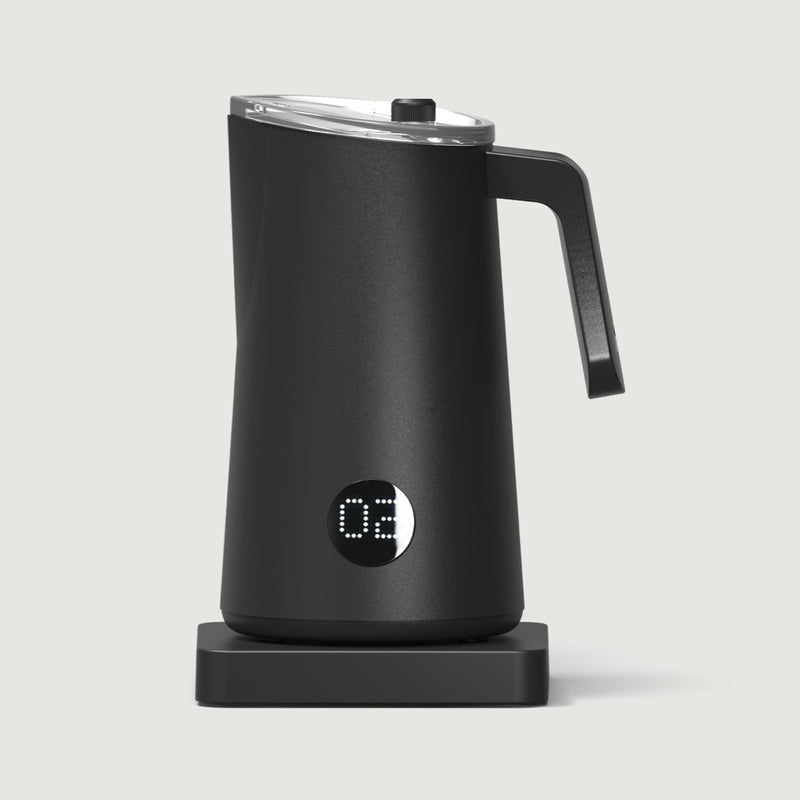
The milk is frothed perfectly! This is an ultimate barista, and the temperature is exactly right! Any other devices that we tried cannot warm up the milk to more than 60 degrees, which makes the coffee average, but this one is mixing the foam and it is perfect for busy mornings! Looooove it!